
Blog
How to Create a Construction Bid: Step-by-Step Guide
Published March 15, 2026 · 7 min read
A well-built bid is the difference between winning profitable work and leaving money on the table. For subcontractors, the bidding process is where your entire project starts — get it right and you set yourself up for healthy margins. Get it wrong and you're either working for free or losing the job to someone who priced it tighter.
This guide walks through each step of putting together a construction bid, from reviewing plans to submitting your proposal. Before you price anything, the invitation should already be a lead on your construction sales CRM — so you know what else is in the pipeline and whether this invite is worth estimating this week.
Key takeaways
- Read the full spec book and every addendum before pricing — missed addenda are one of the most common ways subs leave money out of a bid.
- Price labor at fully burdened rates and your crews' real production rates, not industry averages.
- Get current supplier quotes with a price hold through bid day, and flag long-lead items in your proposal.
- Apply overhead (typically 8-15%) and profit (5-10%) deliberately, in the format the bid documents require.
- Spell out inclusions, exclusions, and assumptions in a clean proposal — and submit it well before the deadline.
Skip the blank page
Our free bid proposal template has the scope, price, inclusions/exclusions, and acceptance sections ready to fill in — and the estimate template does the math behind the number. No email required.
Step 1: Review the Plans and Specifications
Before you touch a calculator, read the plans thoroughly. Go through the spec book section by section — not just your division, but adjacent trades too. You need to understand the full scope so you know where your work starts and stops.
Pay close attention to the general conditions, special conditions, and any addenda. Missed addenda are one of the most common reasons subs leave money out of a bid. Check for phasing requirements, schedule constraints, and liquidated damages clauses that could affect your labor plan.
Step 2: Perform Your Takeoff
The takeoff is the foundation of your bid. Whether you're counting fixtures, measuring linear feet of pipe, or calculating square footage of drywall, accuracy here determines everything downstream.
- Use consistent units. If you're measuring conduit in linear feet, keep everything in linear feet. Mixing units is a fast track to pricing errors.
- Account for waste. Material waste factors vary by trade — 5% for copper pipe, 10-15% for drywall, up to 20% for tile. Use the factor your crews actually experience, not the textbook number.
- Separate by area or phase. Breaking your takeoff into zones or phases makes it easier to verify quantities and adjust if the scope changes later.
Step 3: Price Your Labor
Labor is typically the largest cost in a subcontractor's bid, and it's where most estimating errors happen. Start with your crew composition — how many journeymen, apprentices, and helpers you'll need for each task.
Calculate your fully burdened labor rate, not just the hourly wage. Include payroll taxes (FICA, FUTA, SUTA), workers' comp insurance, health benefits, union contributions if applicable, and any per diem or travel costs. A $45/hour mechanic might actually cost you $72/hour once you load in the burden.
Apply production rates based on your crew's actual performance, not industry averages. If your guys hang 30 sheets of drywall a day on a good day, don't bid it at 40. Build in realistic allowances for mobilization, cleanup, and coordination time.
Step 4: Price Your Materials
Get current quotes from your suppliers — don't rely on old pricing. Material costs fluctuate, and a number that was good three months ago might be 15% higher today. Request quotes with a price hold period so you're covered through bid day and the expected award date.
Include delivery costs, sales tax (if applicable in your jurisdiction), and any specialty items that have long lead times. Flag long-lead items in your proposal so the GC knows about potential schedule impacts.
Step 5: Add Equipment, Subcontractor, and Other Direct Costs
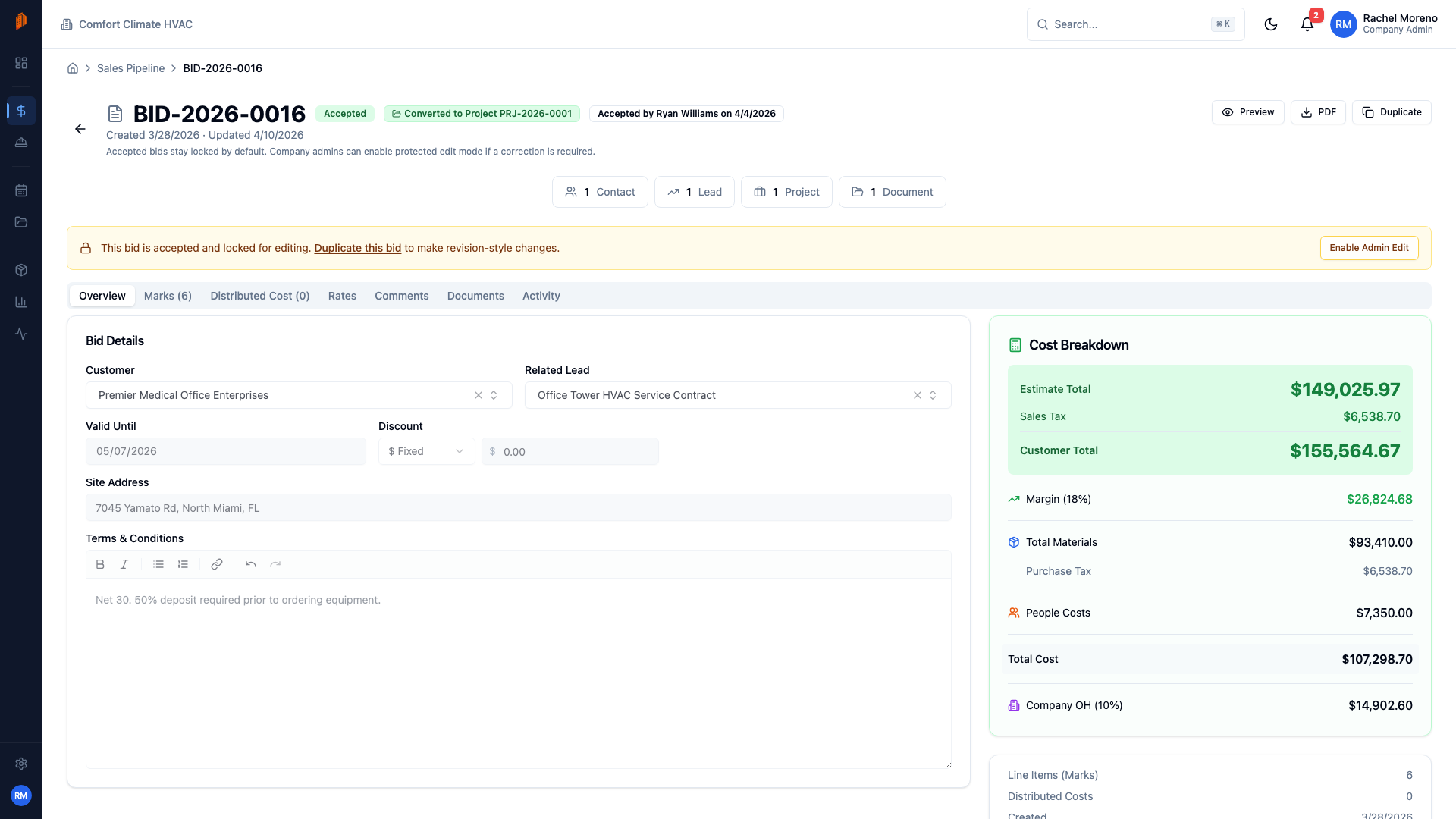
Don't forget the costs that fall between labor and materials. Rented equipment like lifts, scaffolding, or trenchers. Any sub-tier subcontractors you're bringing in. Permits, testing, inspection fees, temporary protection, and dumpster costs. These items add up quickly and are easy to overlook. Structuring your bid as line items with separate material, labor, and other cost buckets — the way bids are built in BuildWorkPro — makes these stray costs easier to catch.
Step 6: Apply Overhead and Profit
Your markup needs to cover two things: overhead (the cost of running your business) and profit (what you actually take home).
- Overhead includes office rent, insurance, vehicles, office staff, accounting, software, and all the other costs that exist whether you have a job or not. Most subs run 8-15% overhead depending on their size and structure.
- Profit is your margin after all costs are covered. 5-10% is common for competitive bids, though some specialty work or negotiated contracts can support higher margins.
Some contractors roll overhead and profit into a single markup. Others break it out on the bid form. Know what the bid documents require and be consistent. Bidding software that applies margin and overhead as rates across your line items keeps the math consistent from one bid to the next.
Step 7: Format and Submit Your Proposal
Presentation matters. A clean, professional proposal tells the GC you run a tight operation. Include a clear scope summary that spells out exactly what's included and — just as importantly — what's excluded. List your qualifications, clarifications, and any assumptions you made.
Common items to clarify in your proposal:
- Work hours (regular time only, or does the schedule require overtime?)
- Access and staging area assumptions
- Whether temporary power, water, or hoisting is provided by others
- Material price escalation clauses for long-duration projects
- Payment terms and retainage expectations
Submit on time. It sounds obvious, but late bids get thrown out. Build in a buffer — if the bid is due at 2:00 PM, have it ready by noon. Use the submission method specified in the invitation: email, online portal, or hard copy.
Common Bidding Mistakes to Avoid
- Bidding every job. Be selective. Chasing too many bids spreads your estimating team thin and leads to sloppy numbers. Reusable bid templates cut estimating time on the jobs you do pursue.
- Forgetting mobilization and demobilization. Getting your crew and equipment to and from the site has a real cost.
- Ignoring the schedule. A compressed schedule means overtime, stacking trades, and lower productivity. Price accordingly.
- Not visiting the site. Plans don't show everything. Site conditions, access limitations, and existing conditions can significantly affect your costs.
Frequently asked questions
How do you create a construction bid?
Start by reviewing the plans, specifications, and every addendum to confirm exactly where your scope starts and stops. Perform a takeoff to quantify the work, price labor at fully burdened rates and materials from current supplier quotes, then add equipment, sub-tier, and other direct costs. Finally, apply overhead and profit markup and submit a clean proposal that spells out inclusions, exclusions, and assumptions before the deadline.
What should a subcontractor include in a bid proposal?
A clear scope summary stating what is included and excluded, plus qualifications, clarifications, and assumptions. Common items to clarify: work hours, access and staging assumptions, whether temporary power or hoisting is provided by others, material escalation clauses for long projects, and payment terms including retainage expectations.
How much markup should a construction bid include?
Markup has to cover overhead and profit. Most subcontractors run 8-15% overhead depending on size and structure, and 5-10% profit is common on competitive bids — specialty or negotiated work can support higher margins. Check whether the bid documents want overhead and profit broken out separately or rolled into a single markup.
What is a fully burdened labor rate?
The true hourly cost of an employee, not just the wage: payroll taxes (FICA, FUTA, SUTA), workers' comp insurance, health benefits, union contributions, and per diem or travel. A $45/hour mechanic can cost $72/hour once the burden is loaded in, so bidding at base wage significantly understates labor cost.
Keep reading
Bidding & Estimating
Build detailed bids with line items, labor rates, markup, and material costs.
Learn moreCreating a Bid Documentation
Step-by-step walkthrough of building your first bid inside BuildWorkPro.
Learn moreBid Line Items
How to structure your bid with materials, labor, equipment, and subcontractor line items.
Learn moreConstruction CRM & Lead Software
Bidding starts with a healthy lead pipeline — track and qualify GC invites first.
Learn more