
Free template
Notice of Commencement (Florida)
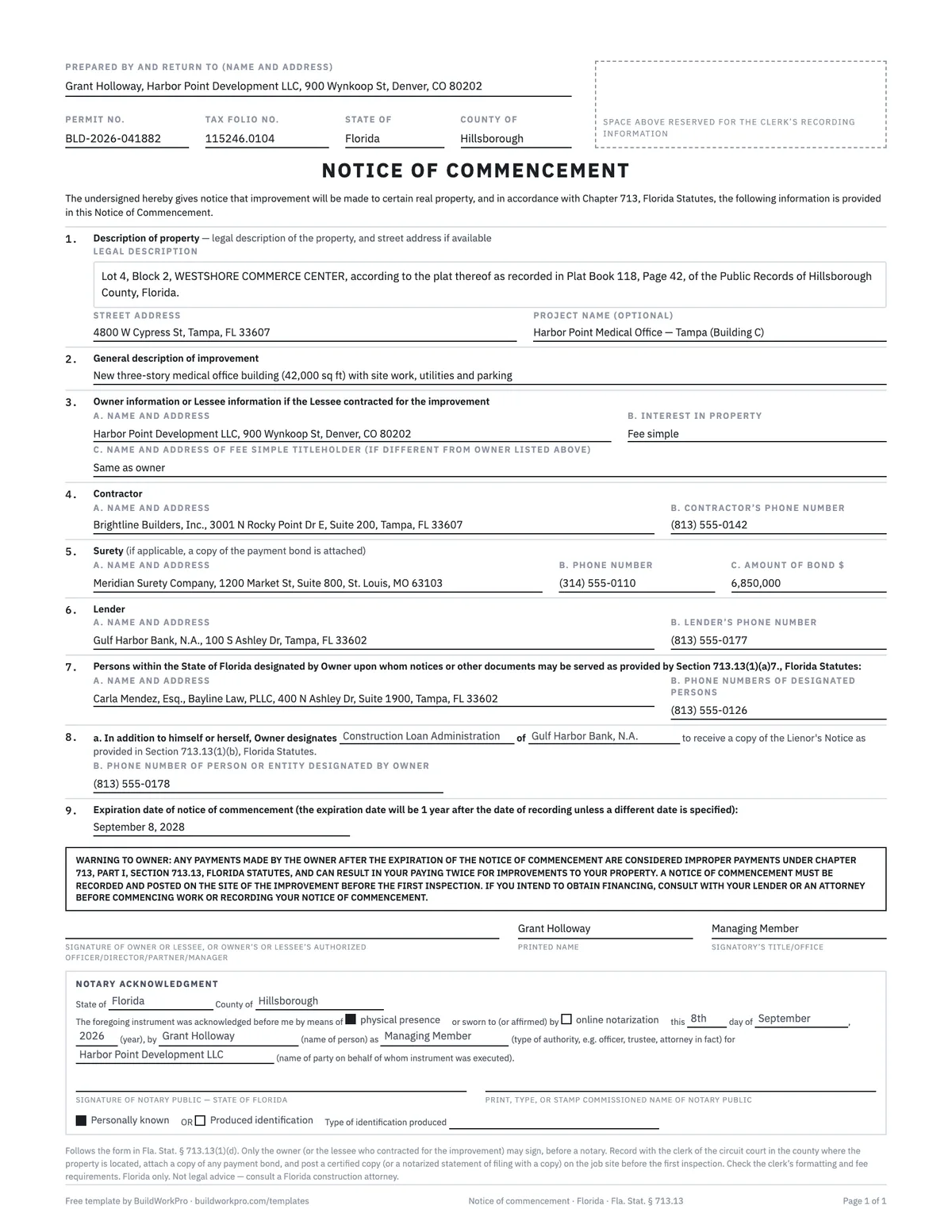
The one-page form a Florida property owner records before construction begins, laid out item by item as § 713.13(1)(d) sets it out — property, improvement, owner, contractor, surety, lender, designated persons and expiration date — with the statutory warning to owner and the Florida notary acknowledgment. Fillable PDF and an editable Word version, plus a completed example.
Free · No email required · Free to use and share for your own business
Updated September 24, 2026 · Built by the BuildWorkPro team, checked on real subcontractor jobs.
What's in the template
How to fill it out
-
1
Get the property details right
Copy the legal description from the deed or the property appraiser’s record, not the street address alone, and add the tax folio number from the same record. The permit number goes at the top once the building department issues it.
-
2
Fill in every party
Owner (or lessee), interest in the property, fee simple titleholder if different, contractor, surety and bond amount if the job is bonded, and the lender if there is construction financing. Leave an item blank only if it truly does not apply.
-
3
Designate who receives notices
Item 7 names a person in Florida who can be served on the owner’s behalf; item 8 names anyone else who should get copies of notices to owner — often the lender. Subcontractors and suppliers will mail their notices to these addresses.
-
4
Set the expiration date
Leave item 9 blank for one year from recording, or state a date that covers the full schedule plus closeout. Payments made after the notice expires are improper payments under the statute.
-
5
Sign, notarize, record and post
The owner signs before a notary. Record the original with the clerk of the circuit court in the property’s county, attach a copy of the payment bond if there is one, and post a certified copy (or a notarized statement of filing with a copy) on the job site before the first inspection.
What a notice of commencement does
Florida’s construction lien law lets subcontractors, sub-subcontractors and suppliers who are not paid claim a lien on the property they improved — even when the owner has paid the general contractor in full. The notice of commencement is how the owner starts that system on the right foot. Recorded before work begins, it puts every future lienor on notice of who the owner, contractor, surety and lender are and where to send their notices, and it gives constructive notice that liens may be recorded against the property with the priority the statute sets.
In practice it is also a permit document: the warning printed on the form says the notice must be recorded and posted on the site before the first inspection, and the building department must accept a recorded notice in the statutory form. Subcontractors pull the recorded notice from the clerk’s records to address their notice to owner.
The form, item by item
- Permit and tax folio numbers, state and county. Header fields from § 713.13(1)(d). The prepared-by block and the blank recording space are for the clerk; check your county’s formatting rules.
- 1. Description of property. The legal description, plus the street address if available. An incorrect description that misleads a lienor can make the owner’s payments improper as to that lienor, so copy it exactly.
- 2. General description of improvement. One line: what is being built or renovated.
- 3. Owner information. Name and address, the interest in the property (fee simple, leasehold), and the fee simple titleholder if different — a tenant build-out lists the tenant as owner and the landlord as titleholder.
- 4–6. Contractor, surety, lender. Names, addresses and phone numbers. If there is a payment bond, state the amount and attach a copy of the bond when you record.
- 7–8. Designated persons. A Florida person who may be served on the owner’s behalf, and an optional additional recipient of notices to owner. A construction lender is typically named in item 8.
- 9. Expiration date. One year after recording unless you specify another date.
- Warning, signature and notary. The warning to owner is statutory and printed verbatim. Only the owner (or an authorized officer, director, partner or manager of an owner entity) signs, before a notary.
A worked example
The completed example is a Florida job for the same owner and general contractor as the rest of our sample set: Harbor Point Development LLC is building a three-story, 42,000 sq ft medical office in Tampa, with Brightline Builders as contractor, a $6,850,000 payment bond from the surety, and construction financing from a bank. The owner names its Tampa attorney in item 7, designates the bank’s construction loan administration in item 8 to receive copies of notices to owner, and — because the build runs close to two years — sets the expiration date at September 8, 2028 instead of accepting the one-year default. It is signed by the owner’s managing member, acknowledged before a notary in person, and recorded on September 8, 2026. The mechanical subcontractor’s notice to owner example is addressed from this notice.
Common mistakes
- Recording it after work or the first inspection has started, or not posting a copy on the site.
- A street address with no legal description, or a legal description for the wrong parcel.
- Letting the contractor sign for the owner — the statute does not allow it.
- Leaving the default one-year term on a job that will run longer, then paying after it expires.
- Forgetting to attach the payment bond, or to amend the notice when information changes.
- Using a Florida form in another state, or another state’s form in Florida.
Once work starts, the payment side of Florida lien law runs on conditional and unconditional lien waivers exchanged with each payment; note that Florida prescribes its own waiver forms in § 713.20. The owner-side contract terms belong in the construction contract.
Keep the recorded notice with the job
Upload the recorded notice of commencement, the permit and the bond to the project’s Documents tab in BuildWorkPro’s project management, tagged by category, so the addresses your team needs for notices and waivers are one click away from the schedule. $79/month flat, 14-day free trial.
See project management in BuildWorkProFrequently asked questions
What is a notice of commencement in Florida?
It is a document the property owner records in the public records before construction starts, under Fla. Stat. § 713.13. It tells everyone who will work on the job who the owner, contractor, surety and lender are, and where notices must be sent. Subcontractors and suppliers use it to address their notices to owner, and the building department expects it before the first inspection.
Who files a notice of commencement — the owner or the contractor?
The owner. The statute says the owner must sign it and no one else may sign in the owner’s stead; a lessee who contracted for the improvement signs as owner and states that its interest is a leasehold. Contractors and permit expediters often prepare the form and carry it to the clerk, but the signature and the notarization are the owner’s.
Where do I record a notice of commencement?
With the clerk of the circuit court (the official records office) in the county where the property is located. Recording is what makes it effective. The owner must also post either a certified copy or a notarized statement that it has been filed, with a copy, on the job site. Check your clerk’s page for recording fees and formatting rules before you print.
How long is a notice of commencement good for?
One year from recording unless the notice states a later expiration date, and it becomes void if the work does not actually start within 90 days after recording. If the contract calls for more than a year to complete, the notice must state a longer effective period. A notice recorded within its effective period can be amended to extend it or correct it; changing contractors takes a new notice.
What happens if the owner pays after the notice of commencement expires?
The statute treats those payments as improper payments, and the warning printed on the form says it plainly: they can result in the owner paying twice for the same improvement if an unpaid subcontractor or supplier later liens the property. That is why item 9, the expiration date, should cover the whole job plus closeout.
Do other states have a notice of commencement?
Several do — Ohio, Georgia, Michigan and Utah, among others, use a filing with the same or a similar name — but the contents, the filing office, who files it and the deadlines tied to it are different in each state. This form follows the Florida statute only. Outside Florida, use your own state’s form and check its rules.
Is a notice of commencement the same as a notice to owner?
No. The owner records the notice of commencement at the start of the job. A notice to owner goes the other way: a subcontractor or supplier who has no contract with the owner serves it on the owner, within 45 days of first furnishing, to preserve its lien rights — using the addresses on the notice of commencement.
Templates that go with this one
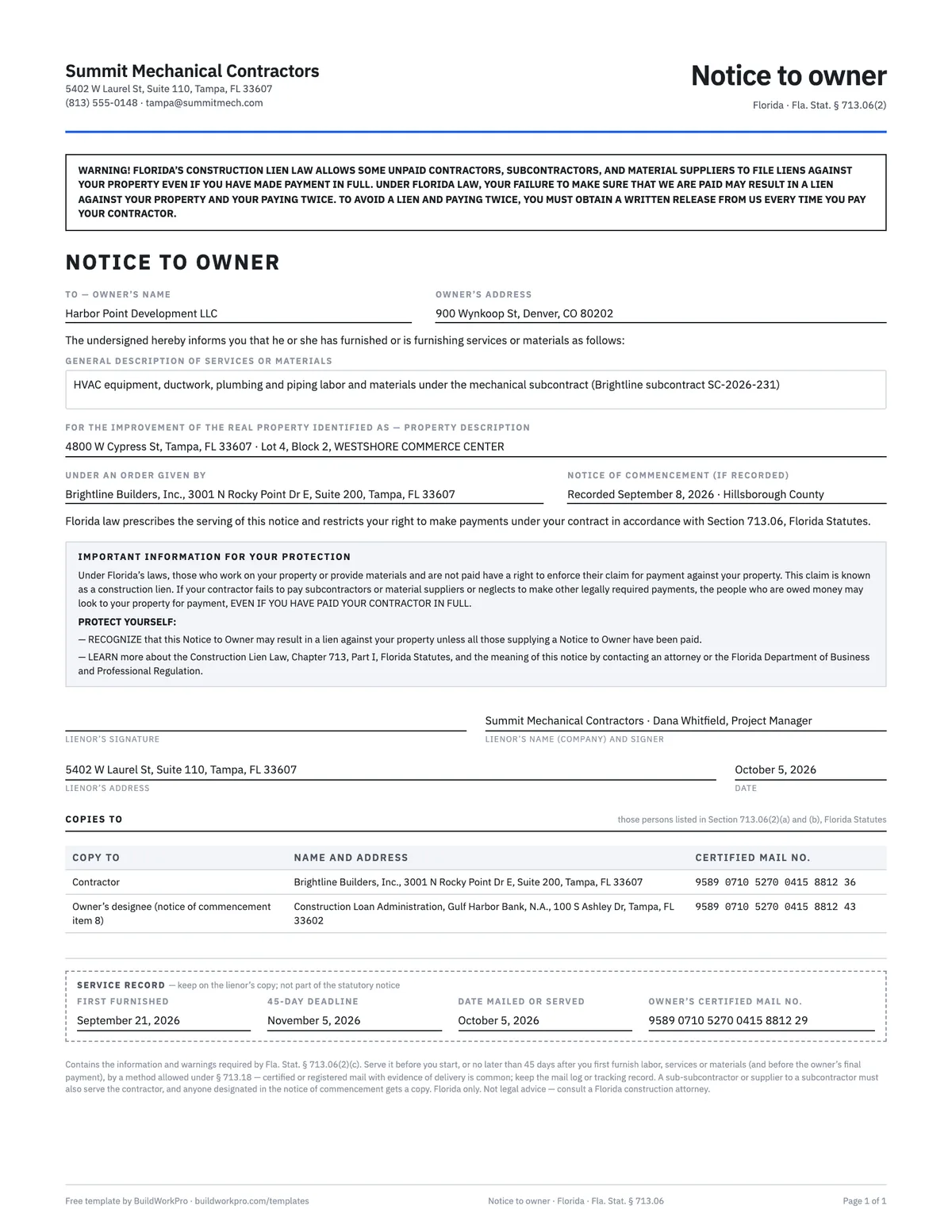
Notice to Owner (Florida)
The Florida preliminary notice under § 713.06 with the statutory warnings, copies-to list and a 45-day service record.
Word · PDF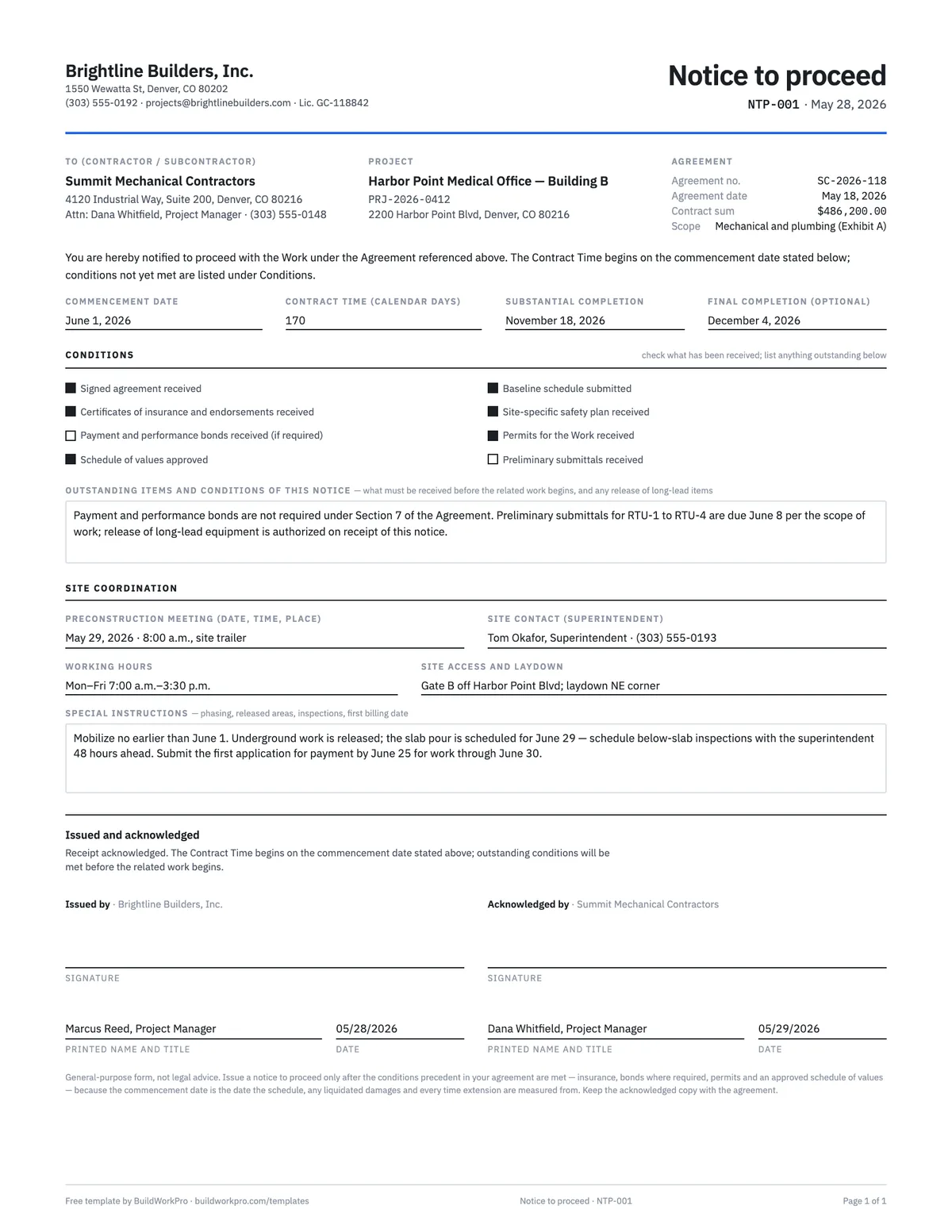
Notice to Proceed Template
Formal start authorization with the contract time clock, conditions and acknowledgment.
Word · PDF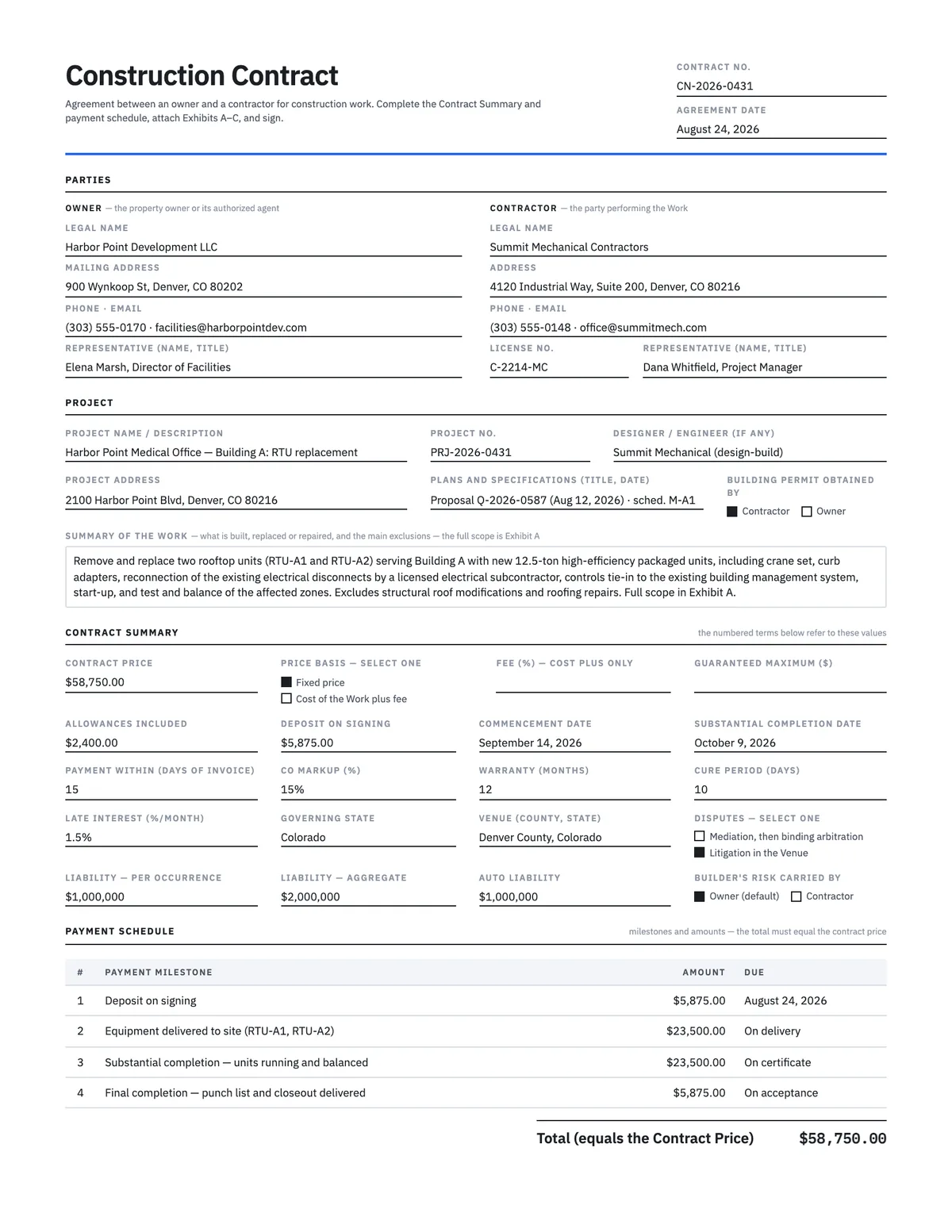
Construction Contract Template
Owner–contractor agreement for direct work: price, payment schedule, changes, warranty and termination.
Word · PDF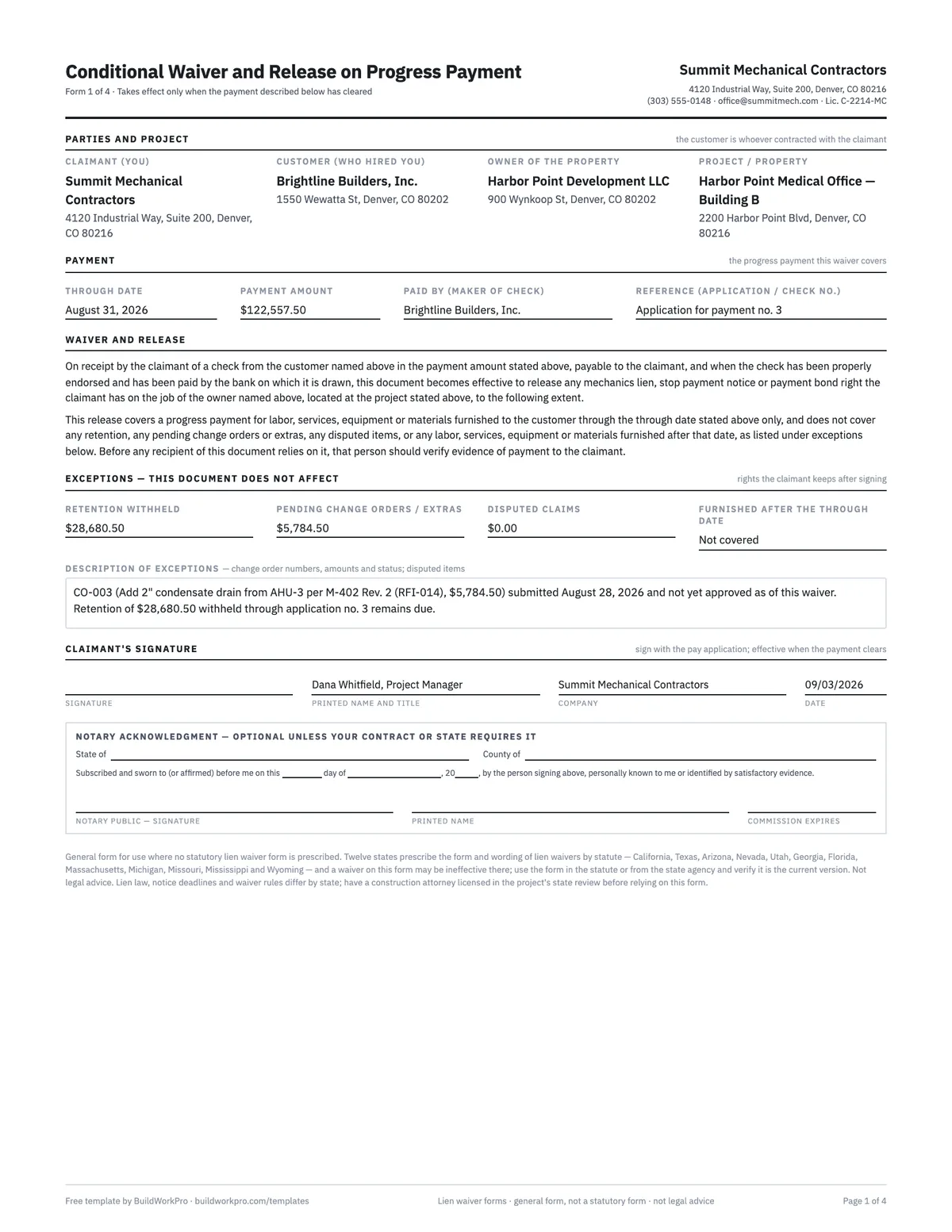
Lien Waiver Forms (4 types)
Conditional and unconditional waivers for progress and final payment, with the exception fields that protect you.
Word · PDFRun the Florida job from one record
BuildWorkPro keeps the project’s documents, schedule, change orders and pay applications together, so the notice of commencement, the bond and every payment it governs live in the same place.
$79/month flat · 14-day free trial · No credit card required
Florida form, not legal advice. The form follows Fla. Stat. § 713.13(1)(d) as published for 2026; statutes change, and county clerks set their own recording requirements. Other states that use a notice of commencement have different forms and rules. Have a Florida construction attorney review before you rely on it.