
Free template
Construction Estimate Template
The pricing worksheet behind every bid: materials, labor, equipment and subcontractors by section, sales tax and contingency on top, then overhead and profit priced as a true margin. An Excel workbook with the math built in, or a one-page fillable PDF.
Free · No email required · Free to use and share for your own business
Updated September 17, 2026 · Built by the BuildWorkPro team, checked on real subcontractor jobs.
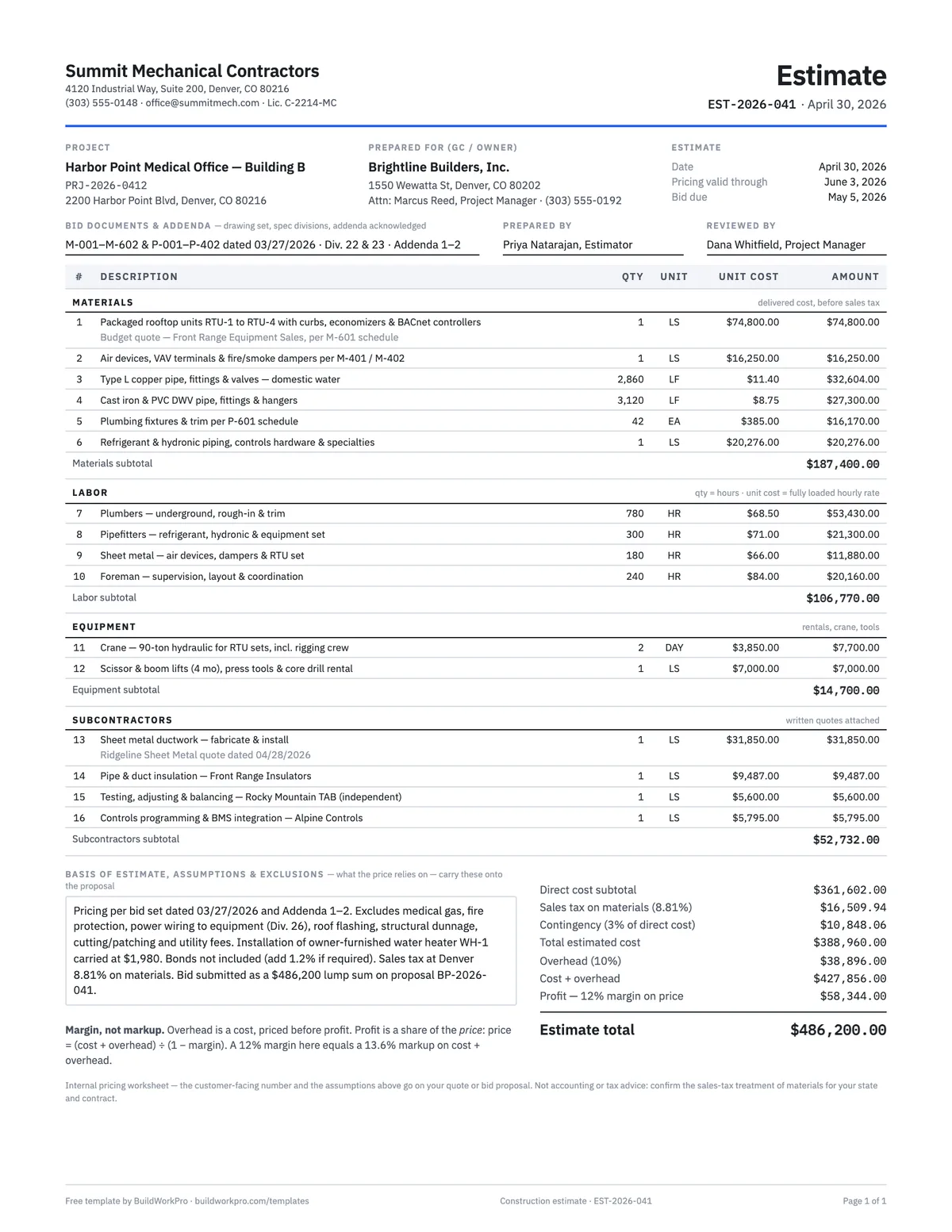
What's in the template
How to fill it out
-
1
Set up the header
Enter your company, the project, the GC or owner the price is going to, and the exact bid documents you priced from — drawing set date, spec divisions, addenda acknowledged. Add a valid-through date and who prepared and reviewed the estimate.
-
2
Price materials and equipment
One line per material package with quantity, unit and delivered unit cost before sales tax. Big-ticket equipment goes in as a lump sum from a written vendor quote; note the quote reference. Crane days, lift rentals and tool rental go under Equipment.
-
3
Price labor as hours × loaded rate
Quantity is hours, unit cost is the fully loaded hourly rate — wage plus payroll taxes, workers’ comp, liability and benefits. Use one line per trade or crew so you can see where the hours are, and include supervision.
-
4
Add subcontractor quotes, then run the ladder
Enter each sub quote as a lump sum. Set your sales-tax rate, contingency, overhead and profit margin: the Excel computes direct cost, tax, contingency, total cost, overhead and profit; the PDF gives you a line for each. The check rows show the equivalent markup and confirm the margin.
-
5
Write the basis of estimate and carry the number forward
List what the price assumes and excludes — bonds, permits, tax treatment, owner-furnished items, drawings used. Then take the estimate total and those assumptions onto your quote or bid proposal. The estimate itself stays in your file as the cost budget for the job.
What a construction estimate is — and what it is not
A construction estimate is the internal build-up of what a job will cost you and what you need to charge for it. It lists the materials you will buy, the hours you will spend, the equipment you will rent and the subcontractors you will hire, adds the costs that ride on top (sales tax, contingency, overhead), and finishes with the profit you intend to keep. It is a worksheet, and its audience is you.
It is not the document the customer signs. That is a quote for a small, direct, fixed-price job, or a bid proposal for a competitive bid to a GC. Both carry the number this worksheet produces; neither should show the unit costs and margin behind it. And once the job is won, the estimate has a third life: its sections become the job cost budget you track actual costs against, and they map onto the schedule of values you bill from.
The pricing ladder, line by line
The four sections above the ladder are just quantity × unit cost. The ladder is where estimates go wrong, so the template makes every step explicit:
| Line | What it is |
|---|---|
| Direct cost subtotal | Materials + labor + equipment + subcontractors |
| Sales tax on materials | Your local rate × the materials subtotal. Leave it at 0% if tax is already in your unit costs or the project is exempt |
| Contingency | A percentage of direct cost for the unknowns in the documents — priced as a cost, before overhead |
| Total estimated cost | Direct cost + tax + contingency. This is the number that becomes your job cost budget |
| Overhead | Office, trucks, insurance, estimating time — a real cost, applied before profit |
| Profit | Set as a margin on price: (cost + overhead) ÷ (1 − margin) − (cost + overhead) |
| Estimate total | Cost + overhead + profit — the lump sum that goes on the proposal |
Two check rows in the Excel version show the equivalent markup on cost + overhead and recompute profit ÷ price, so the margin you entered is the margin you get.
Markup vs. margin — the mistake this template is built around
Markup is a percentage of cost. Margin is a percentage of price. A 15% markup on $10,000 of cost gives an $11,500 price, but $1,500 ÷ $11,500 is only a 13% margin. To keep 15% of the price you have to mark cost up 17.6%. Most estimating spreadsheets multiply cost by a markup and call it the margin; over a year of bids the difference is real money that was never priced.
This template prices by margin. Overhead goes on first, as a cost, and profit is solved from the price: price = (cost + overhead) ÷ (1 − margin). The workbook’s Markup vs Margin sheet has a live calculator and a conversion table (10% markup = 9.1% margin, 25% = 20%, 50% = 33.3%). To check a number without the workbook, use the free markup vs margin calculator; the full explanation is in our guide to markup vs. margin in construction.
A worked example: a $486,200 mechanical bid
The completed example is the estimate behind a mechanical subcontract on a medical office building — the same job that appears on our change order, schedule of values and pay application templates, so the numbers reconcile across the set. Materials come to $187,400 (rooftop units at $74,800 from a vendor budget quote, copper, DWV pipe, fixtures, controls hardware), labor to $106,770 across plumbers, pipefitters, sheet metal and a foreman at loaded rates of $66 to $84 an hour, equipment to $14,700 (two crane days for the RTU sets, lifts, tools), and four subcontractor quotes to $52,732. Direct cost: $361,602.
Denver sales tax at 8.81% on the materials adds $16,509.94 and a 3% contingency adds $10,848.06, for a total estimated cost of $388,960. Overhead at 10% is $38,896, and profit at a 12% margin is $58,344 — an estimate total of $486,200.00, which was submitted as the lump-sum base bid and became the contract sum. The same profit expressed as a markup is 13.6%: the number an estimator who prices by markup would have needed to type, and usually did not.
Estimate vs. quote vs. bid proposal vs. schedule of values
- Estimate — internal; cost by section plus the ladder; the source of the number and, later, the cost budget.
- Quote — customer-facing, fixed price, one page, for small direct jobs; line items at sell price, options, deposit, acceptance signature. Quote template.
- Bid proposal — customer-facing, for competitive work; scope, base bid with alternates, inclusions and exclusions, terms. Bid proposal template.
- Schedule of values — after award; the contract sum broken into billable lines for monthly pay applications. SOV template.
The relationship is one-way: the estimate feeds the others. If the proposal total and the estimate total ever differ, the estimate is the one that explains why.
Estimate templates by trade
This worksheet is for pricing a bid to a GC or owner against drawings and specs. If you sell directly to homeowners or property managers, start from a customer-ready estimate built for your trade instead. Each one comes with a takeoff sheet that does your trade's quantity math: roofing (squares and pitch), HVAC (duct runs and line-set charge), electrical (device counts to labor hours), plumbing (fixture rough-in and trim), concrete (cubic yards, base and rebar), drywall (board count and mud), painting (paintable area and gallons), flooring (square footage with waste), fence (posts, pickets and concrete bags) and landscaping (sod, mulch and plants). For work without its own template, the free calculators do the takeoff math: the deck calculator counts boards, joists, footings and screws, the asphalt calculator turns area and compacted thickness into tons and truckloads, and the stair stringer calculator works out risers, treads and stringer stock.
Common estimating mistakes this template is built to catch
- Pricing labor at the wage instead of the loaded rate — the single biggest quiet loss. The free labor burden calculator works out the loaded rate from the wage.
- Forgetting sales tax on materials, or applying it to labor and subs as well.
- Multiplying by a markup and reporting it as a margin.
- Taking overhead out of profit instead of pricing it as a cost.
- Carrying no contingency on an incomplete drawing set, then eating the RFIs.
- Accepting the lowest sub quote without leveling scope — use the bid tabulation template before you pick one.
- Leaving the basis of estimate blank, so the exclusions never make it onto the proposal.
For the full process from takeoff to submission, read how to create a construction bid; for the math, markup vs. margin.
Estimate from a catalog, not a blank spreadsheet
In BuildWorkPro every bid is built from line items typed as material, labor or other cost, priced from a reusable product catalog, with margin, overhead and commission applied as rates on the Rates tab — then exported as a branded PDF proposal, sent for e-signature, and converted into a project the moment it is accepted. Construction bidding software for $79/month flat, 14-day free trial.
See estimating in BuildWorkProFrequently asked questions
What should a construction estimate include?
Line items with quantities and units, split into materials, labor, equipment and subcontractors so each section has its own subtotal; sales tax on materials; a contingency; overhead as a cost; profit as a margin; and the basis of the estimate — the drawing set, addenda, assumptions and exclusions the price relies on. Separating cost types is what makes the number defensible when a customer pushes back, and what lets you turn the estimate into a job cost budget once you win.
What is the difference between an estimate, a quote and a bid?
An estimate is your internal build-up of cost and price. A quote is a fixed-price offer to a customer for defined work — usually a smaller, direct job. A bid is a formal offer in a competitive selection, normally to a GC against drawings and specs, wrapped in a proposal with scope, inclusions, exclusions and terms. This template is the estimate; the number it produces goes onto the quote or the bid proposal.
Should I use markup or margin to price the job?
Price by margin. Markup is a percentage added to cost; margin is a percentage of the selling price — and a 15% markup is only a 13% margin. Contractors who price by markup routinely keep less profit than they think. The template prices by true margin: price = (cost + overhead) ÷ (1 − margin), and the Markup vs Margin sheet shows the conversion so you can see what your usual markup has really been earning.
How do I price labor in an estimate?
Hours × a fully loaded labor rate — the wage plus payroll taxes, workers’ comp, liability insurance and benefits, not the bare wage. On the template, labor lines use quantity for hours and unit cost for the loaded rate, one line per trade or crew, so a $34 wage that really costs you $68.50 an hour gets priced at $68.50.
How much contingency should a construction estimate carry?
Enough to cover the unknowns in the documents you priced from, not the unknowns in your own takeoff. Two to five percent of direct cost is common on complete bid sets; more on early or incomplete drawings. The template applies contingency as a percentage of direct cost before overhead and profit, so it is priced as a cost, and the completed example carries 3%.
What overhead percentage should I use?
Your real one. Add up a year of office rent, trucks, insurance, estimating time, software and admin salaries, and divide by that year’s direct job costs — most subcontractors land between 8% and 15%. Enter that rate in the overhead line. The point of applying overhead before profit is that a job which only covers overhead has made you nothing yet.
Should I send the estimate itself to the customer?
Usually not. The estimate is the worksheet — it shows your unit costs, labor rates and margin, which invites line-item shopping. Send the customer-facing document instead: a quote for a small fixed-price job or a bid proposal for a competitive one, with a lump sum, alternates broken out, and the assumptions and exclusions from the basis-of-estimate box carried across.
Templates that go with this one
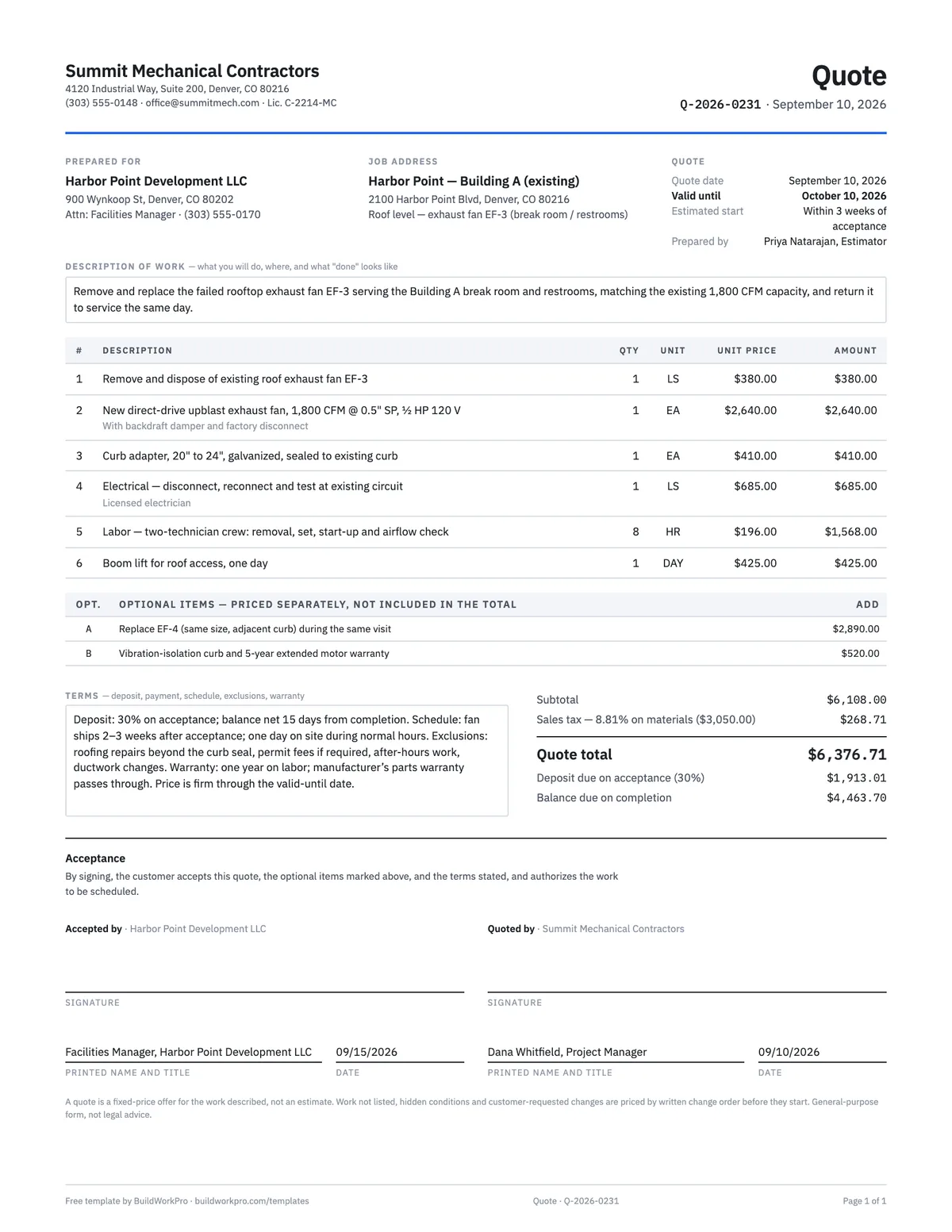
Construction Quote Template
One-page fixed-price quote with line items, options, validity date and acceptance signature.
Excel · Word · PDF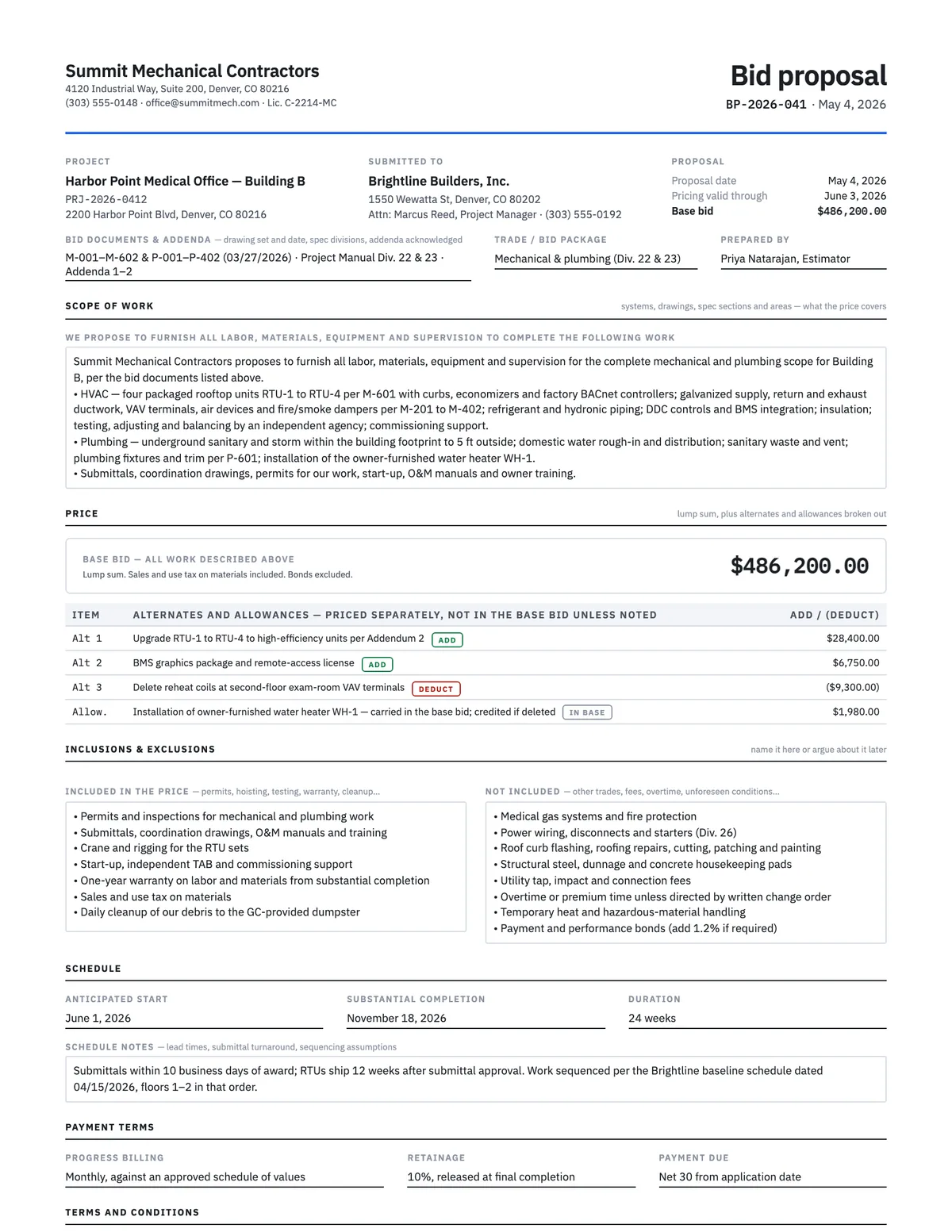
Construction Bid Proposal Template
Scope, price with alternates, inclusions and exclusions, terms and an acceptance block.
Word · PDF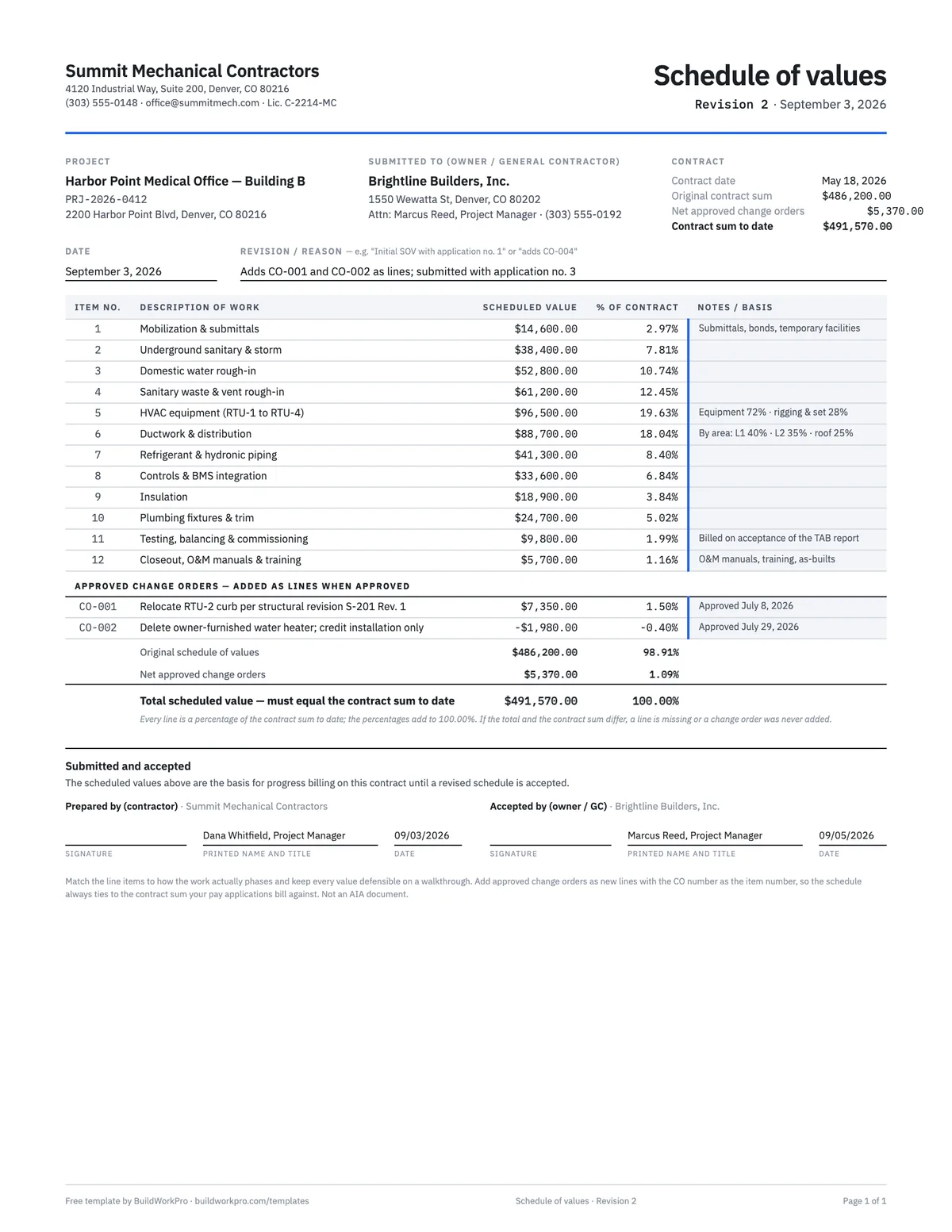
Schedule of Values Template
Break the contract sum into billable line items with % of contract math and a tie-out check.
Excel · PDF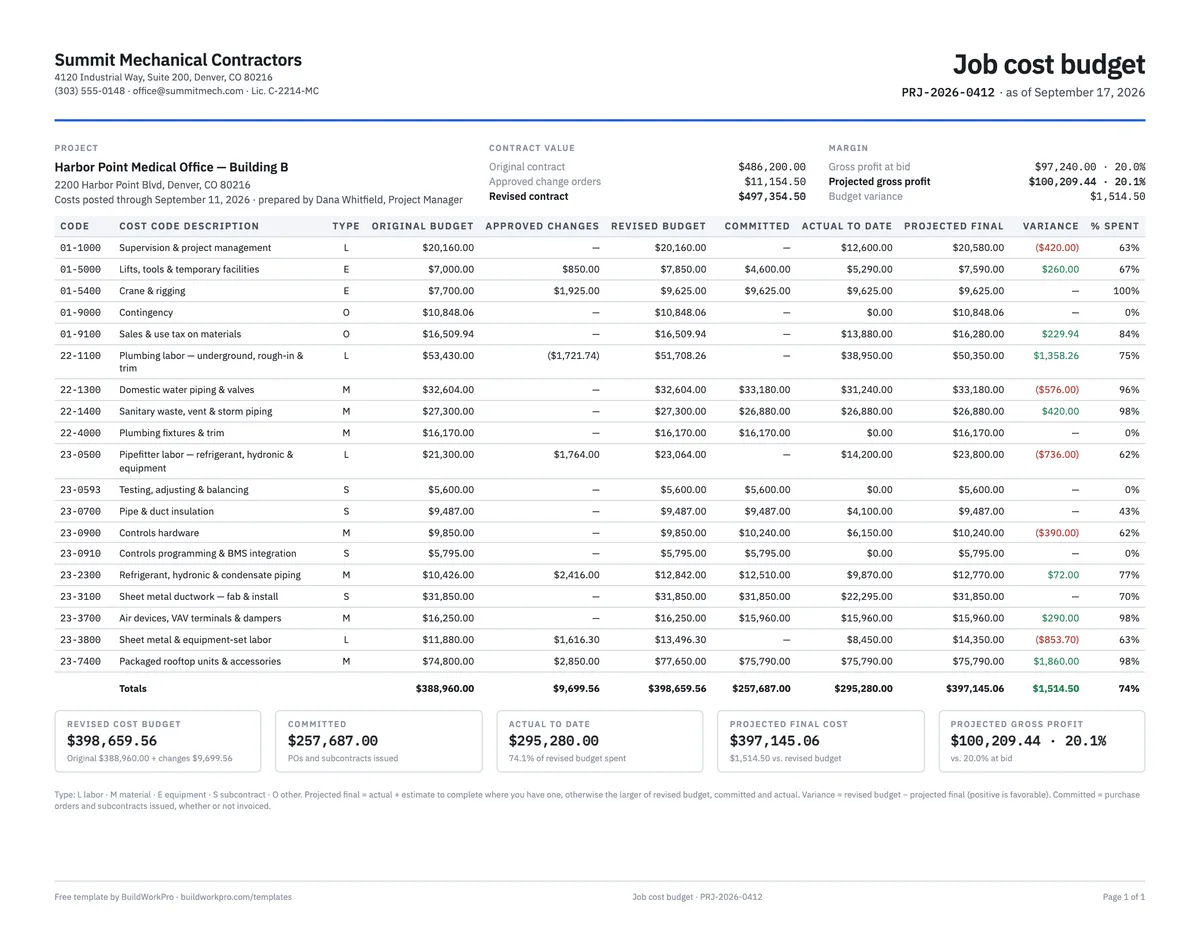
Construction Budget Template
Budget vs. committed vs. actual by cost code, with variance and cost-to-complete.
Excel · PDFFree calculators and price data for this work: Markup vs Margin Calculator · Labor Burden Calculator · Construction material prices
Price it once, sell it everywhere
BuildWorkPro pulls line items from your product catalog, applies your labor rates and margin systematically, exports the client-ready proposal, collects the e-signature and converts the win into a project — no retyping.
$79/month flat · 14-day free trial · No credit card required
Internal pricing worksheet, not accounting or tax advice. Sales-tax treatment of construction materials varies by state and by contract — confirm yours before relying on the tax line.