
Free template
Fence Estimate Template
A customer-ready fence estimate grouped the way fence contractors price the job: removal and layout, posts and framing, then pickets, panels and gates. The Excel version includes a fence takeoff sheet that turns run lengths, gates and hole sizes into posts, rails, pickets and bags of concrete.
Free · No email required · Free to use and share for your own business
Updated September 28, 2026 · Built by the BuildWorkPro team, checked on real subcontractor jobs.

What's in the template
How to fill it out
-
1
Walk the line and take it off
On the Fence Takeoff sheet, enter each straight run between end, corner and gate posts, then the gates and the hole size for line and gate posts. Sections, posts, rails, pickets, concrete bags and gate hardware calculate from your post spacing, picket width and bag yield.
-
2
Build your unit prices
On the Unit Price Builder, enter material cost, labor hours and other cost per post, bag, rail, foot or gate, along with your loaded labor rate, overhead and profit margin. Use your own crews’ production rates, not a rule of thumb.
-
3
Fill in the customer and job specs
Enter the customer, the job address and the specs customers compare between fence companies: length, height and style, material, gates and how the posts are set. Write the scope in two or three plain sentences.
-
4
Price each phase, then set tax and deposit
Enter the line items under removal and layout, posts and framing, and pickets and gates with quantity, unit and unit price. Mark taxable lines and enter your rate, or leave tax at 0% if it is in your prices, and set the deposit percentage.
-
5
Add options and terms, then get it signed
List upgrades such as a cap board or stain outside the total. Write the terms: deposit, property line, rock and private utility lines, and warranty, with a valid-until date. Collect the signature and deposit before you order material.
What goes on a fence estimate
A homeowner pricing a fence usually has two or three estimates side by side, and compares them on a handful of facts: how many feet, how tall, what material, how many gates and how the posts go in. Those are the job specs under the header. With them on the page, the customer can line your number up against the others. Without them, the cheapest estimate looks like the same fence.
The line items follow the order the crew builds in:
- Removal and layout: tearing out the old fence and its footings, haul-off, and stringing the line from the survey pins after the 811 locate.
- Posts and framing: line posts, upsized gate posts, the concrete to set them, rails and a kickboard.
- Pickets, panels and gates: pickets or panels by the foot, each gate with its hardware, the permit and final cleanup.
Upgrades the customer might want, such as a cap board or stain, go in the optional-items table, priced but outside the total.
How to take off a fence
Start from a sketch of the line with every corner, end and gate marked, then split it into straight runs from one terminal post to the next. A run’s sections are its length divided by your post spacing, rounded up, and its line posts are the sections minus one. End, corner and gate posts are added once each. Counting “sections plus one” on every run counts each corner twice.
Rails are sections times rails per section. Pickets per run are the run length in inches divided by the picket width plus the gap, rounded up; a 1×6 is 5½ inches wide. Concrete comes from the hole: π × (diameter ÷ 2)² × the concrete depth, less the post, divided by 1,728 for cubic feet, then divided by the bag’s yield. An 80-lb bag yields about 0.60 cubic feet, but check the bag.
| Hole × concrete depth | Post | Concrete | 80-lb bags |
|---|---|---|---|
| 8 in. × 24 in. | 4×4 | 0.53 cu ft | 0.9 |
| 10 in. × 24 in. | 4×4 | 0.92 cu ft | 1.5 |
| 10 in. × 30 in. | 4×4 | 1.15 cu ft | 1.9 |
| 10 in. × 36 in. | 4×4 | 1.38 cu ft | 2.3 |
| 12 in. × 36 in. | 4×4 | 2.10 cu ft | 3.5 |
| 12 in. × 36 in. | 6×6 | 1.73 cu ft | 2.9 |
Hole diameter drives concrete more than anything else: a 12-inch hole takes about half again the concrete of a 10-inch hole at the same depth. Depth is set by frost, soil and your local code, not by the template, so it is an input. The Fence Takeoff sheet runs the whole calculation for up to ten runs and four gates, with every spacing, width and yield editable. For one straight run, the free fence calculator does the same math in your browser, prices it with your own rates and adds each run to a running estimate.
Pricing a fence line by line
Price gate posts separately from line posts. They carry the gate’s weight and swing, so they are usually a size up and set deeper, and the price should show it. Price pickets or panels by the foot of fence, so a customer who shortens a run can see what it saves. Build every unit price from cost on the Unit Price Builder: material, labor hours at your loaded rate and consumables, then overhead, then profit as a margin on price rather than a markup. A 15% markup on cost is only a 13% margin.
The completed example tears out an old wood fence outside Columbus, Ohio and builds 180 LF of 6-foot cedar privacy fence on pressure-treated posts, with a 4-foot walk gate and a 10-foot double drive gate. Removal and layout come to $1,470, posts and framing to $4,546.60, and pickets, gates and the permit to $4,733. That is $10,749.60, or about $59.72 per foot of fence line all-in. The fence alone, without removal, gates and the permit, is about $45.39 per foot. There is no tax line because the contractor pays tax on materials and includes it in the prices. The 35% deposit is $3,762.36.
Property lines, 811 and rock
Three things on a fence job can’t be seen when you write the estimate, and each one needs a sentence in the terms.
- The property line. The owner identifies the line and the pins, and the estimate says where the fence sits relative to it: 2 inches inside in the example. If nobody can find the pins, recommend a survey before you dig.
- Utilities. Request an 811 locate before digging. It marks public lines, not the owner’s sprinkler pipe, pet-fence wire or landscape lighting, so the terms ask the owner to mark those.
- Rock and old footings. Price a hole that stops the auger per hole, with photos: $65 in the example.
Anything that changes after the estimate is signed, such as an added gate, a run moved for the HOA or a slope that needs stepped sections, gets written up as a change order and signed before the work is done. When the fence is finished, bill the balance on an invoice that references the estimate number and lists the approved changes.
Estimate, quote or proposal?
For most residential fences, this customer-facing estimate is the whole sale: specs, a price, terms and a signature. If the customer only needs a fixed price on one page without the phase breakdown, a construction quote does that. On commercial fencing bid to a GC or property owner against drawings and specs, build your cost on the construction estimate worksheet and send a bid proposal with inclusions, exclusions and alternates instead.
Common mistakes on fence estimates
- Counting one extra post per run. Corners are shared, so “sections plus one” double-counts them.
- Pricing gate posts like line posts. They carry the gate; upsize them, set them deeper and price that.
- One concrete figure per post regardless of hole size. A 12-inch hole takes about half again the concrete of a 10-inch one.
- No property-line language. When a neighbor objects, the company that set the fence gets the first call.
- No price for rock. Without a per-hole price in writing, rock becomes a negotiation in the yard.
Price fences from a catalog, not a blank spreadsheet
In BuildWorkPro every estimate is a bid built from line items priced from your product catalog, with margin and overhead applied as rates. It goes out as a branded PDF for e-signature and converts into a project when the customer accepts. Construction bidding software for $79/month flat, with a 14-day free trial.
See estimating in BuildWorkProFrequently asked questions
How do you calculate how many fence posts you need?
Split the fence line at every corner, end and gate. For each straight run, divide the length by your post spacing and round up to get the sections; the line posts are the sections minus one. Then add each end, corner and gate post once. In the completed example, 166 feet of runs at 8-foot spacing is 23 sections and 18 line posts, plus 4 end and corner posts and 4 gate posts: 26 posts.
How many bags of concrete do I need per fence post?
Work out the concrete around the post: π × (hole diameter ÷ 2)² × the concrete depth, less the post, divided by 1,728 to get cubic feet. Divide that by the yield printed on the bag; an 80-lb bag of concrete yields about 0.60 cubic feet. A 10-inch hole with 30 inches of concrete around a 4×4 takes about 1.9 bags, and a 12-inch hole with 36 inches around a 6×6 about 2.9.
What should a fence estimate include?
The fence length, height, style and material; the gates; how the posts are set; line items for removal, haul-off, layout, posts, concrete, rails, pickets or panels, gates and the permit; optional items priced separately; the deposit and payment terms; who identifies the property line; how rock and buried debris are billed; the warranty; a valid-until date; and a signature line for acceptance.
Who is responsible for the property line on a fence job?
Put it on the owner in writing. The estimate should say the owner identifies the line and the survey pins, and where the fence sits relative to the line, such as 2 inches inside. If nobody can find the pins, a survey costs less than moving a fence. Setbacks and height limits vary by city and HOA, so check them before you dig.
Do you need to call 811 before digging fence post holes?
Yes. State one-call laws require a locate request before you dig, and the notice period varies by state. 811 marks public utility lines only. Private lines such as sprinkler pipe, pet-fence wire, landscape lighting or a feed to a detached garage are the owner’s to mark, which is why the example’s terms say so.
Do you need a permit to build a fence?
Often. Many cities require a permit or zoning approval for a new fence, especially in front yards, on corner lots or above a set height, and many HOAs must approve the style, height and color first. Check with the city’s building or zoning department and the HOA before you schedule. The completed example carries the permit and HOA submittal as its own line.
How do you price a fence per linear foot?
Build it from the parts rather than quoting one flat number: posts, concrete, rails, kickboard and pickets per foot of fence, then gates, removal and the permit as their own lines. In the completed example the fence itself works out to about $45.39 per foot, and the whole job, with removal, two gates and the permit, to about $59.72 per foot of fence line. Your number depends on material, height, soil and your crews’ production.
Templates that go with this one
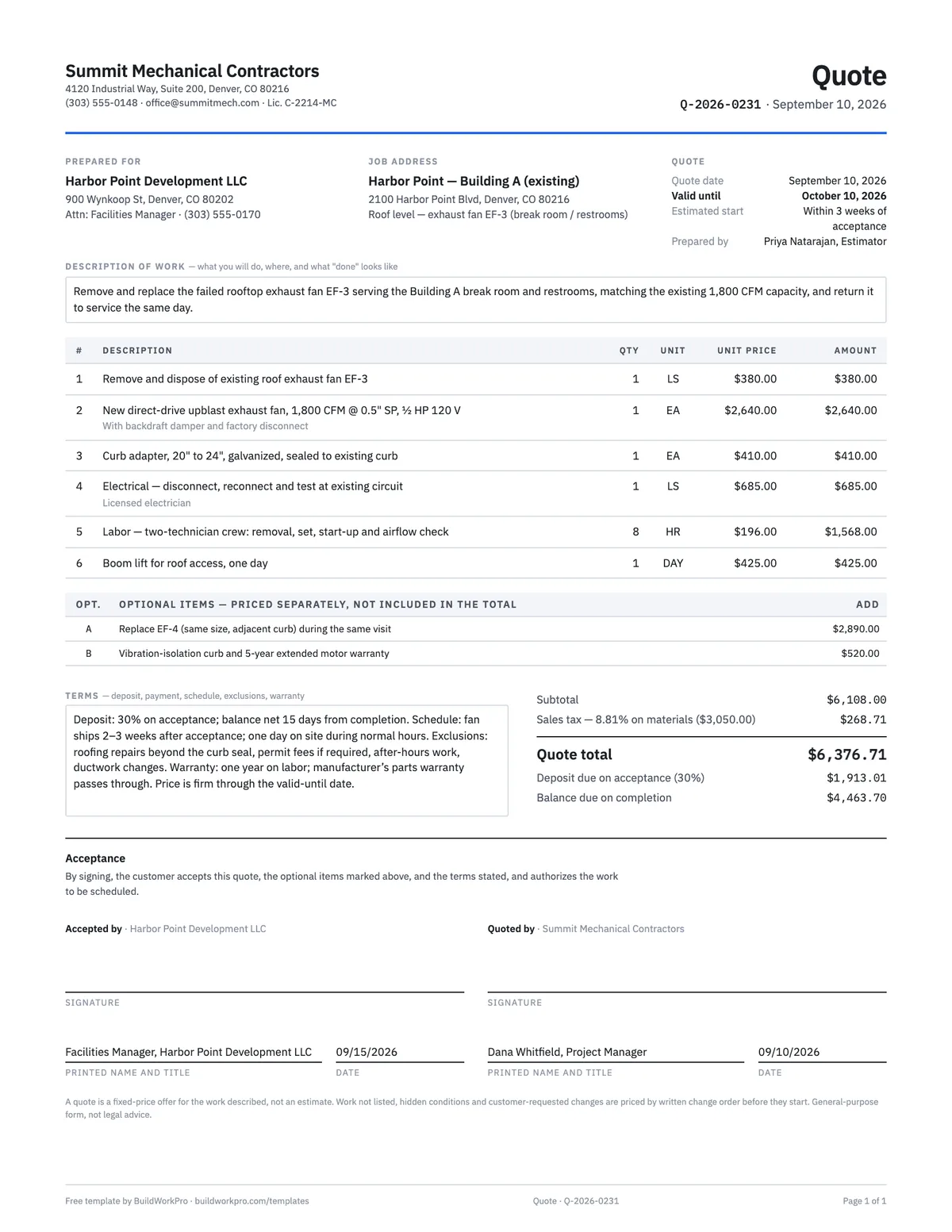
Construction Quote Template
One-page fixed-price quote with line items, options, validity date and acceptance signature.
Excel · Word · PDF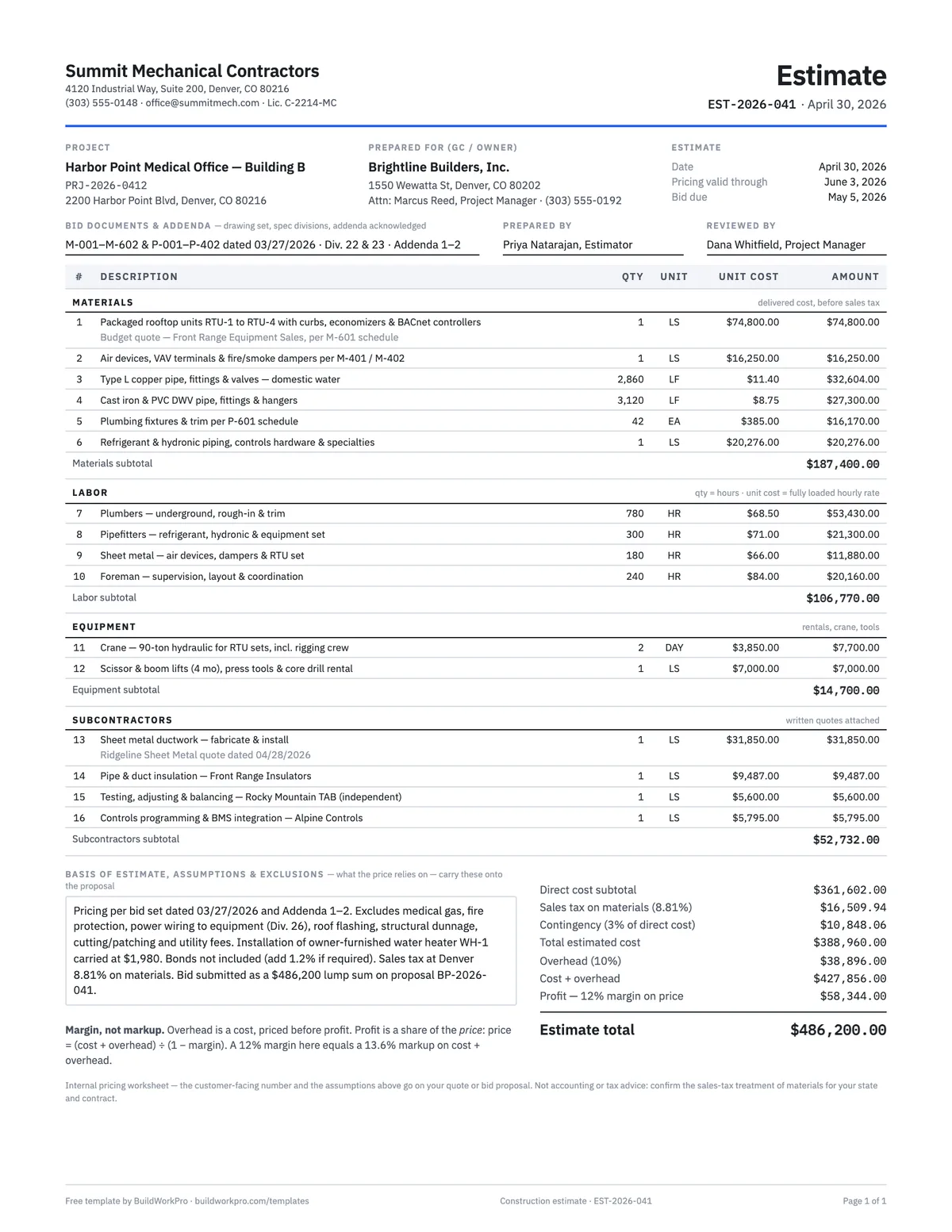
Construction Estimate Template
Material, labor, equipment and subs by section, with overhead and true-margin pricing.
Excel · PDF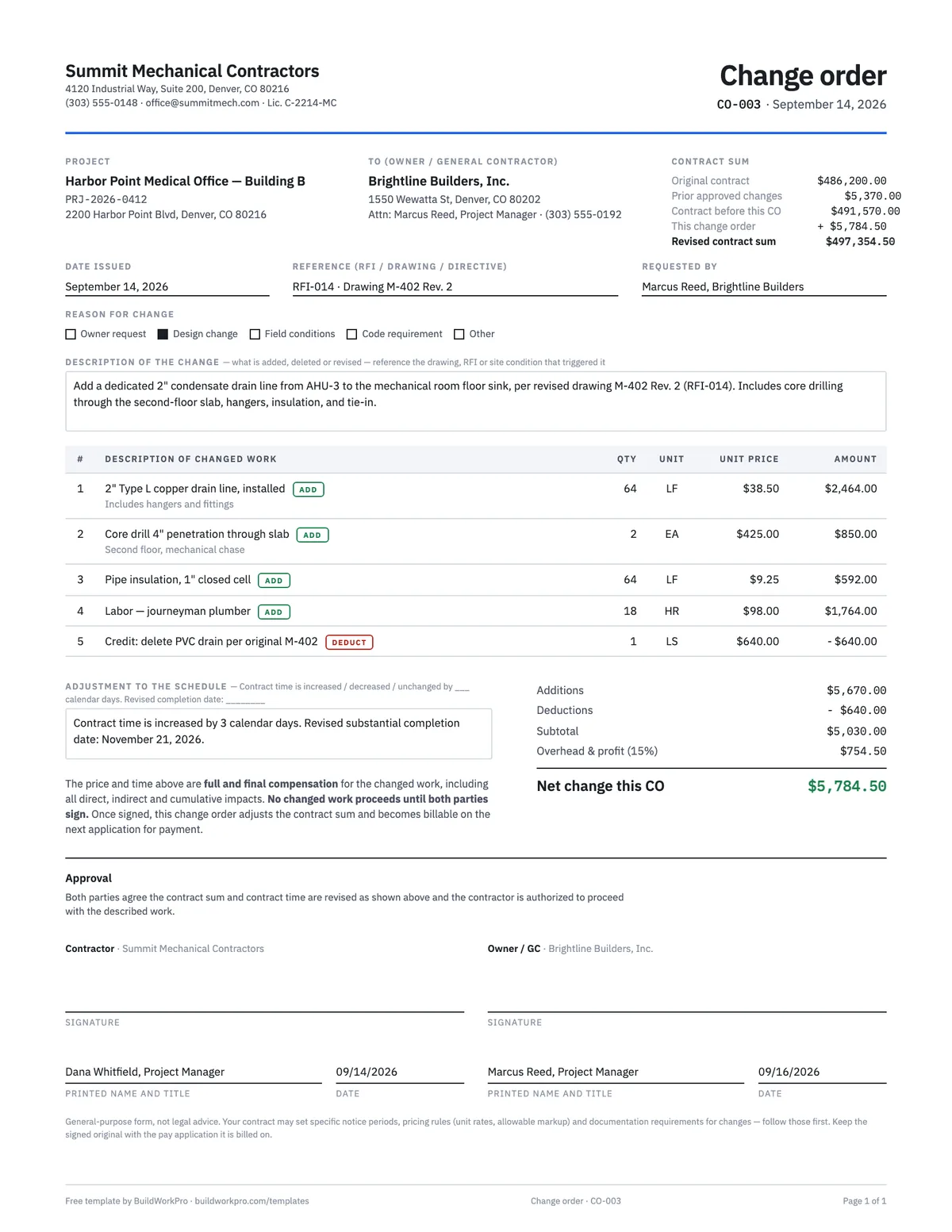
Construction Change Order Template
Price the change, adjust the contract sum and schedule, and get both signatures before the work starts.
PDF · Word · Excel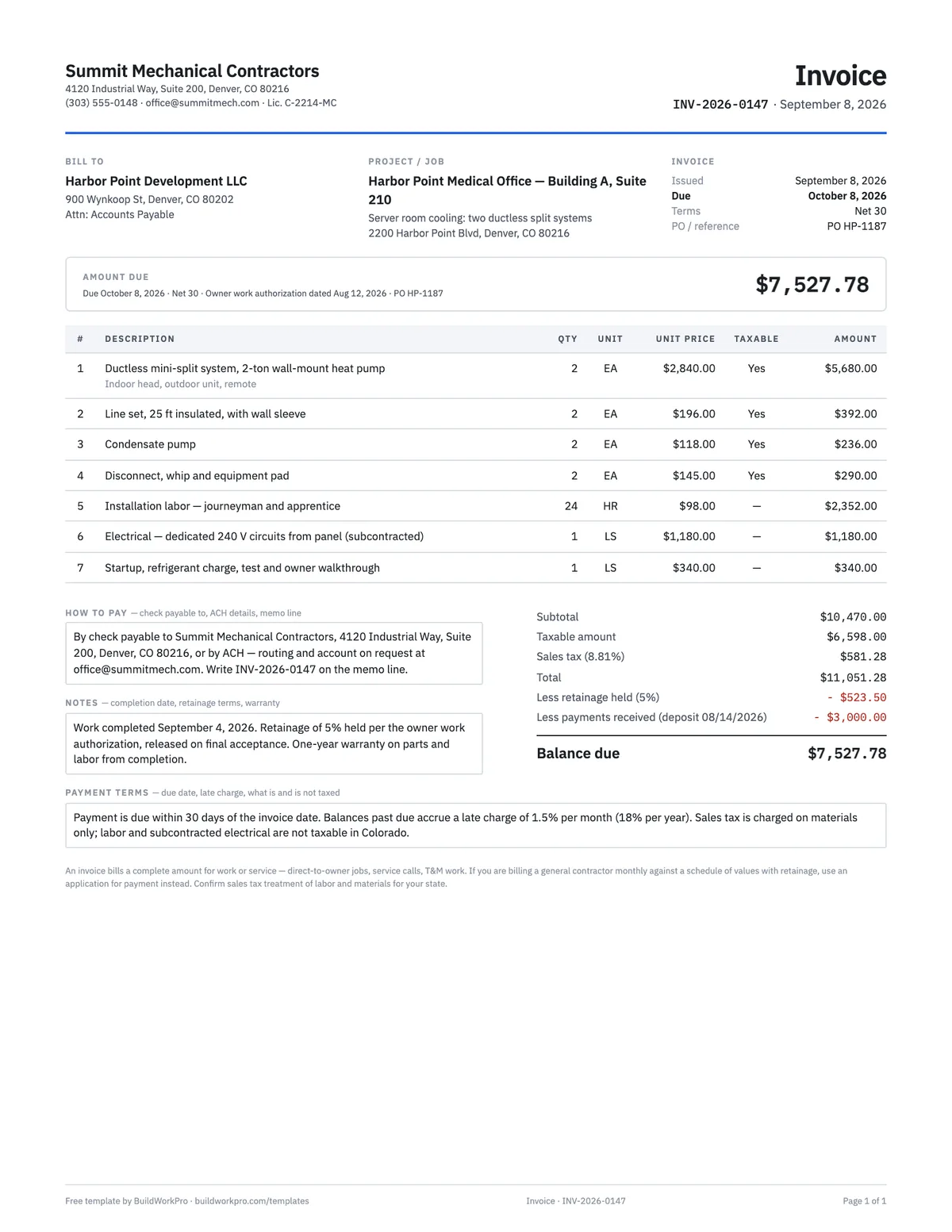
Contractor Invoice Template
Line items with computed amounts, sales tax, retainage and balance due — for work billed directly, not through a GC.
Excel · Word · PDFEstimate templates for other trades: Roofing · Landscaping · Painting · HVAC · Electrical · Plumbing · Concrete · Drywall · Flooring
Free calculators and price data for this work: Fence Calculator · Deck Calculator · Lumber Prices
Stop retyping the same fence
BuildWorkPro keeps your post, rail, picket and gate prices in a catalog, applies your margin to every line, sends the estimate for e-signature and turns the accepted job into a project. Change orders, invoices and photos stay on the same job.
$79/month flat · 14-day free trial · No credit card required
General-purpose estimate form, not legal advice. Home-improvement contract rules such as deposit limits, cancellation notices and license disclosures vary by state. Fence permits, setbacks, height limits and post depth are set locally: confirm them with the city and the HOA, request an 811 locate before digging, and check material specs with the manufacturer.