
Free template
Construction Bid Proposal Template
The proposal wrapper around your number: scope of work, base bid with alternates and allowances, the inclusions and exclusions that prevent disputes, schedule, payment terms, and an acceptance block that makes the win official. An editable Word document, or a PDF with the page-one fields fillable.
Free · No email required · Free to use and share for your own business
Updated September 17, 2026 · Built by the BuildWorkPro team, checked on real subcontractor jobs.
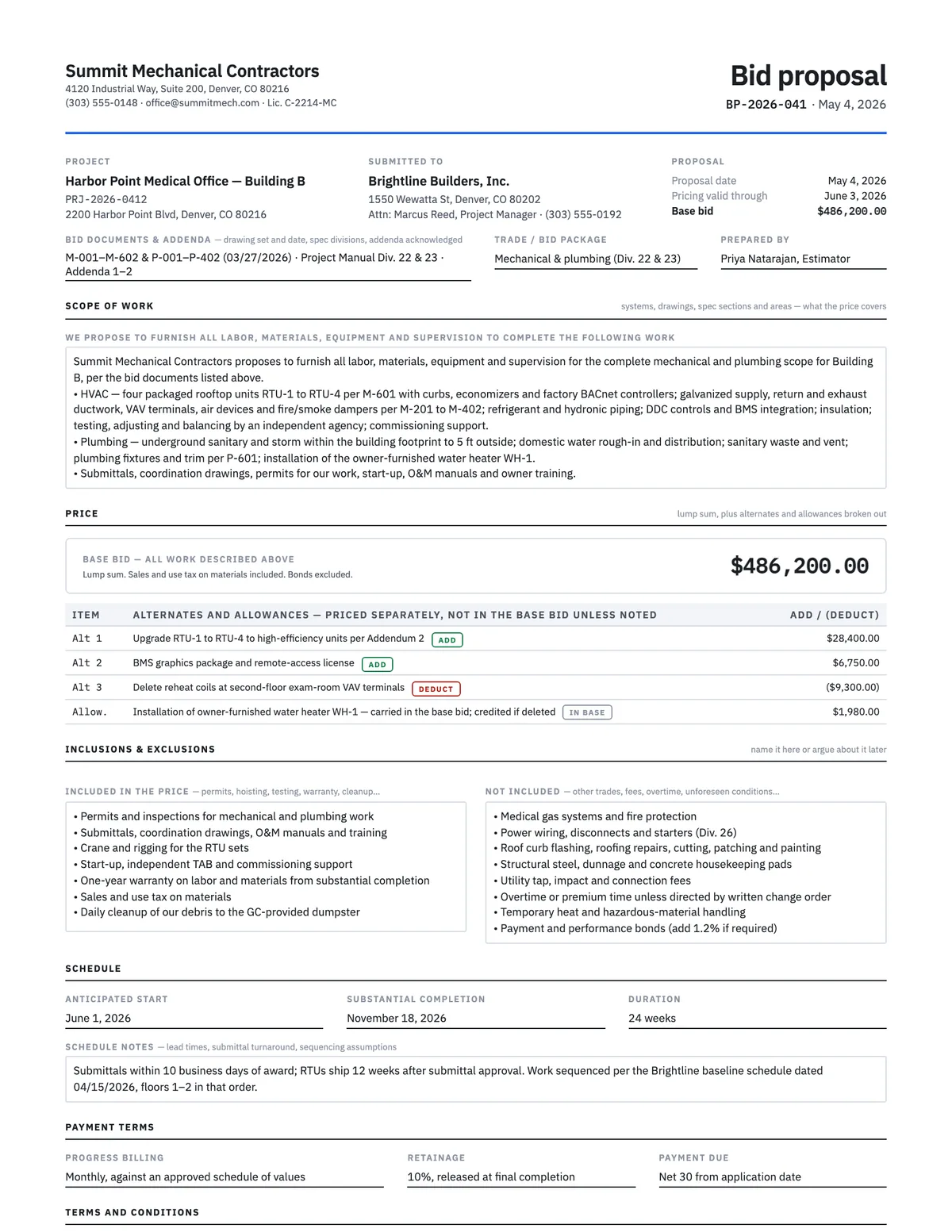
What's in the template
How to fill it out
-
1
Number it, date it, and name the documents
Use your proposal sequence, set the pricing-valid-through date (30 days is typical), and write down exactly which drawings, spec divisions and addenda the price is based on. If the GC issues Addendum 3 after you submit, that line is what protects your number.
-
2
Write the scope by system
One short paragraph saying you furnish all labor, materials, equipment and supervision, then bullets by system or area referencing sheet numbers and spec sections. Specific beats long: the scope section is what you point to when extra work appears.
-
3
Price it: base bid, then alternates and allowances
The base bid is one lump sum for the scope above — the number from your estimate. Put every owner option in the alternates table as an add or (deduct), and any amount carried for undefined work as an allowance, so nobody can compare your base bid to a competitor’s that quietly excluded something.
-
4
Name the inclusions and the exclusions
Inclusions: permits you pull, submittals, hoisting, testing, start-up, warranty, cleanup, sales tax. Exclusions: other trades, cutting and patching, painting, fees, overtime, bonds, unforeseen conditions. Write the exclusions as if the dispute has already started.
-
5
Set the schedule and terms, sign, and send
Fill in start and completion dates, lead times, progress billing, retainage and payment due. Read the six clauses and edit anything that does not fit your contract or state. Sign it, send it, and when it comes back signed, file it with the subcontract — it is what you negotiate the subcontract from.
What a bid proposal is (and why the exclusions matter most)
A construction bid proposal is the customer-facing offer: a price, the scope that price buys, the conditions attached to it, and a line for the customer to accept. It is the document a GC reads to decide whether your $486,200 and a competitor’s $471,000 are actually for the same work — and, months later, the document everyone re-reads when something you never priced turns out to be expected.
That second reading is why the exclusions list is the most valuable paragraph you will write. A scope section says what you will do; an exclusions list says what you will not do, in words the other side has already accepted. Power wiring to your equipment, roof flashing, cutting and patching, utility fees, bonds, overtime: each one you name is an argument you never have. The number behind the proposal comes from the construction estimate template; this page is about everything wrapped around that number.
Section by section
- Bid documents and addenda. Drawing set and date, spec divisions, addenda acknowledged. If the documents change after you submit, this line is your price protection.
- Scope of work. One sentence promising labor, materials, equipment and supervision, then bullets by system with sheet and spec references. Reference the documents; do not restate them.
- Base bid. One lump sum for the scope above. Say whether sales tax on materials is included and whether bonds are.
- Alternates and allowances. Priced options as adds and (deducts); allowances carried in the base bid with the note that they adjust to actual cost.
- Inclusions and exclusions. Side by side so a reader sees both at once.
- Schedule. Start, substantial completion, duration, and the lead times your dates depend on — submittal turnaround, equipment ship dates.
- Payment terms and conditions. Progress billing, retainage, payment due, then six short clauses: validity, payment, changes in writing, schedule, insurance and warranty, and what happens when the proposal is accepted.
- Acceptance. Two signature blocks. When the second one is signed, this is an agreement.
A worked example: the $486,200 Harbor Point proposal
The completed example is a mechanical subcontractor’s proposal to a general contractor for the plumbing and HVAC scope of a medical office building, dated May 4, 2026 and valid for 30 days. The base bid is $486,200.00 — the estimate total from the estimate template’s example — with sales tax on materials included and bonds excluded. Three alternates sit under it: high-efficiency rooftop units per Addendum 2 (add $28,400), a BMS graphics package (add $6,750), and deleting the exam-room reheat coils (deduct $9,300). One allowance is called out inside the base bid: $1,980 to install an owner-furnished water heater, credited if deleted.
That allowance is the kind of detail a proposal earns its keep on. On our change order template the same job later deletes the water heater installation, and the credit is exactly $1,980 — no negotiation, because the proposal already said what it was worth. The schedule runs June 1 to November 18, 2026, progress billing is monthly against a schedule of values with 10% retainage, and the GC signed the acceptance on May 18 — which is the contract date on every other document in the set.
Bid vs. proposal vs. quote vs. estimate
The words blur in practice, so here is how the four documents divide the work:
- Estimate — internal cost build-up by section, with overhead and margin. Never sent as-is. Template.
- Bid — the price itself, submitted into a competitive selection, often on the GC’s bid form.
- Proposal — the bid plus scope, alternates, inclusions, exclusions, schedule and terms, with an acceptance line. This template.
- Quote — a one-page fixed-price offer for a small direct job, with line items, a deposit and an acceptance signature. Template.
After acceptance the proposal is usually followed by a subcontract on the GC’s form, sometimes with a letter of intent in between to release early work. The agreement clause in this template makes the proposal the deal until that subcontract exists, and requires the subcontract to be consistent with it — read the subcontract against your exclusions before you sign.
Alternates, allowances and unit prices
Owners rarely have every decision made at bid time. Alternates let them decide later without re-bidding: price each one as a clean add or deduct against the base bid, with the same inclusions and exclusions, and never fold them into the lump sum. Allowances cover things that cannot be priced yet — a fixture package still being selected — and should be stated as carried amounts that adjust to actual cost with a written change order. If the bid form asks for unit prices, provide them as a separate schedule for adds and deducts, with a note that they apply to changes ordered in writing, not to correcting quantities in the documents.
Common mistakes this form is built to prevent
- No validity date — a proposal from March becomes a contract price in September.
- Scope written as a restatement of the spec instead of a list of what you are doing.
- Exclusions left generic ("anything not listed") — courts and GCs read that as nothing.
- Alternates buried in the lump sum, making your base bid look high against a stripped one.
- No schedule assumptions, so a late submittal approval becomes your delay.
- Payment terms missing retainage, so the subcontract sets it at whatever the GC wants.
- Sending the estimate instead of the proposal and inviting line-item negotiation.
The full process from plans to submission is in our guide to how to create a construction bid. Pair this proposal with the scope of work template when the scope needs more room than a page, and with the subcontractor agreement for what comes next.
Send it, sign it, start the job
BuildWorkPro builds the bid from your catalog with margin and overhead applied as rates, exports a branded PDF proposal with your scope, payment terms and conditions, sends it for legally binding e-signature, and converts the accepted bid into a project — reminders included. Construction bidding software for $79/month flat, 14-day free trial.
See bidding in BuildWorkProFrequently asked questions
What should a construction bid proposal include?
A clear scope of work, the price (with alternates and allowances broken out), what is included, what is excluded, the schedule, the terms — how long the price holds, how you get paid, how changes are handled — and an acceptance signature block. The exclusions list is the most valuable paragraph: every exclusion you name is a dispute you never have.
What is the difference between a bid and a proposal?
A bid is usually a price submitted into a competitive selection — often to a GC, against drawings and specs. A proposal is the fuller document around that price: scope, inclusions, exclusions, schedule, terms, and an acceptance line. This template is the proposal wrapper; pair it with our free estimate template for the math behind the number.
Should I show one lump sum or itemized pricing?
Lead with the lump sum and break out alternates and allowances separately. Full line-item transparency invites line-item shopping; a single defensible number with clearly priced alternates keeps the negotiation on scope, not on your unit costs. If the bid form requires unit prices, add them as a separate schedule rather than exposing the whole estimate.
How long should my pricing stay valid?
Thirty days is common; volatile material markets argue for less. The template carries a pricing-valid-through date and a validity clause with an escalation provision, so an old proposal cannot bind you to old prices.
What are alternates and allowances?
An alternate is a priced option the owner can add or deduct — a higher-efficiency unit, a deleted scope item — shown as its own line so the base bid stays comparable. An allowance is an amount carried inside the base bid for something not yet defined, to be adjusted to actual cost. Both belong in the proposal in their own table, never buried in the lump sum.
What is the difference between an accepted proposal and a subcontract?
An accepted proposal is an agreement on your terms; a subcontract is an agreement on the GC’s. The template’s agreement clause says the proposal governs unless superseded by a mutually executed subcontract consistent with it, which is why your inclusions, exclusions and terms need to be complete here — they are what you will be negotiating from. See our free subcontractor agreement template for what usually follows.
Can the client sign the proposal electronically?
Yes — e-signatures are legally binding in the United States under the ESIGN Act. BuildWorkPro sends your bid for legally binding e-signature from an emailed link, chases the reminders, files the certified signed PDF on the record, and converts the accepted bid straight into a project.
Templates that go with this one
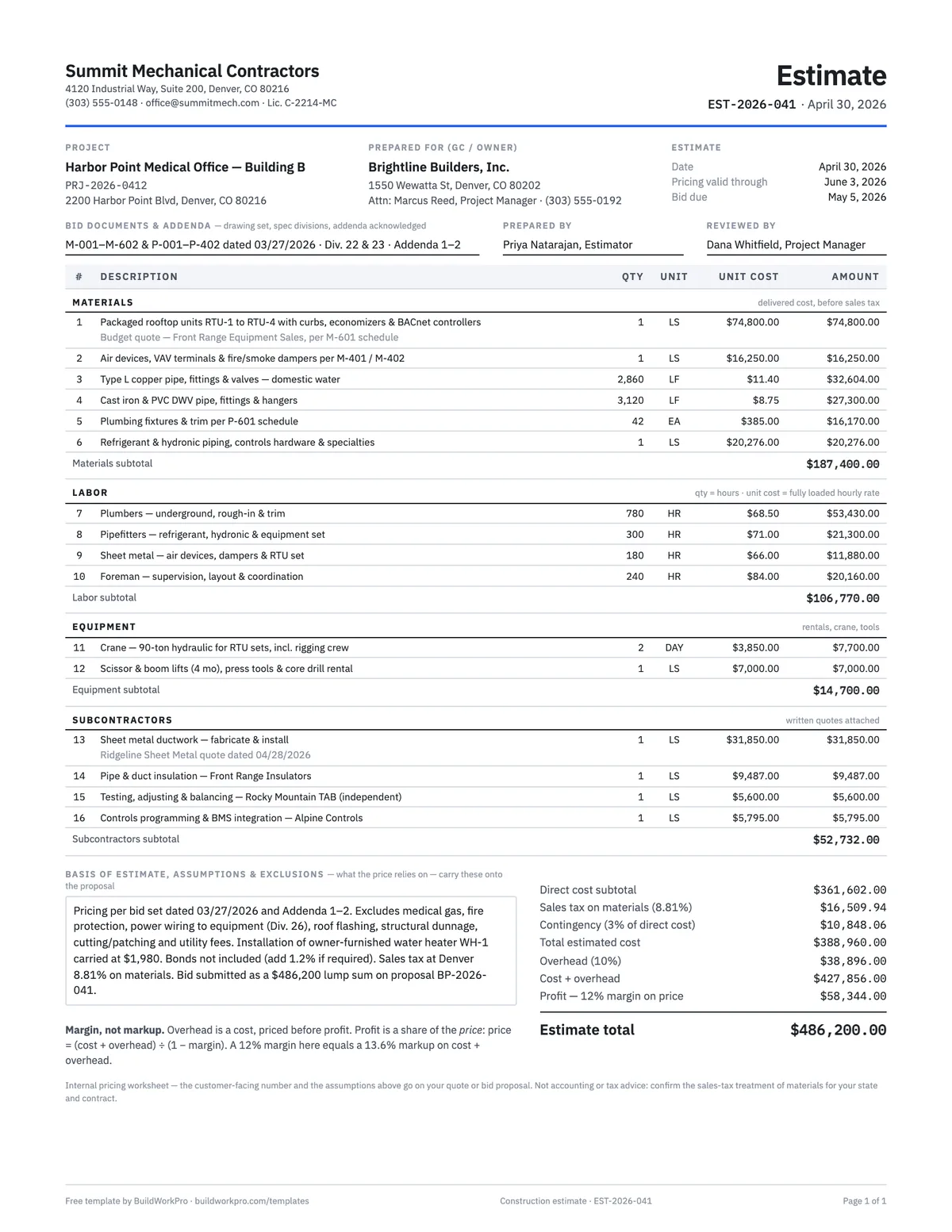
Construction Estimate Template
Material, labor, equipment and subs by section, with overhead and true-margin pricing.
Excel · PDF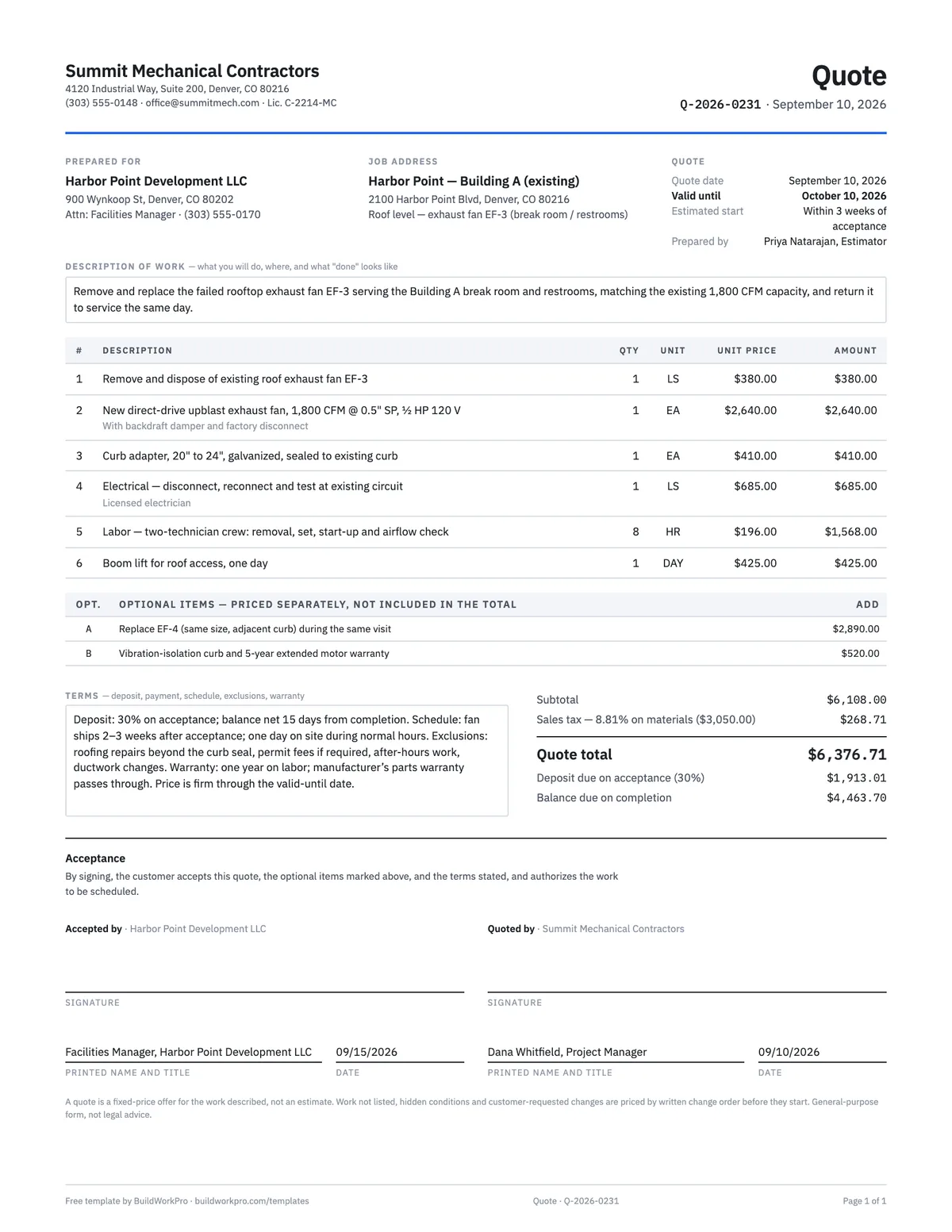
Construction Quote Template
One-page fixed-price quote with line items, options, validity date and acceptance signature.
Excel · Word · PDF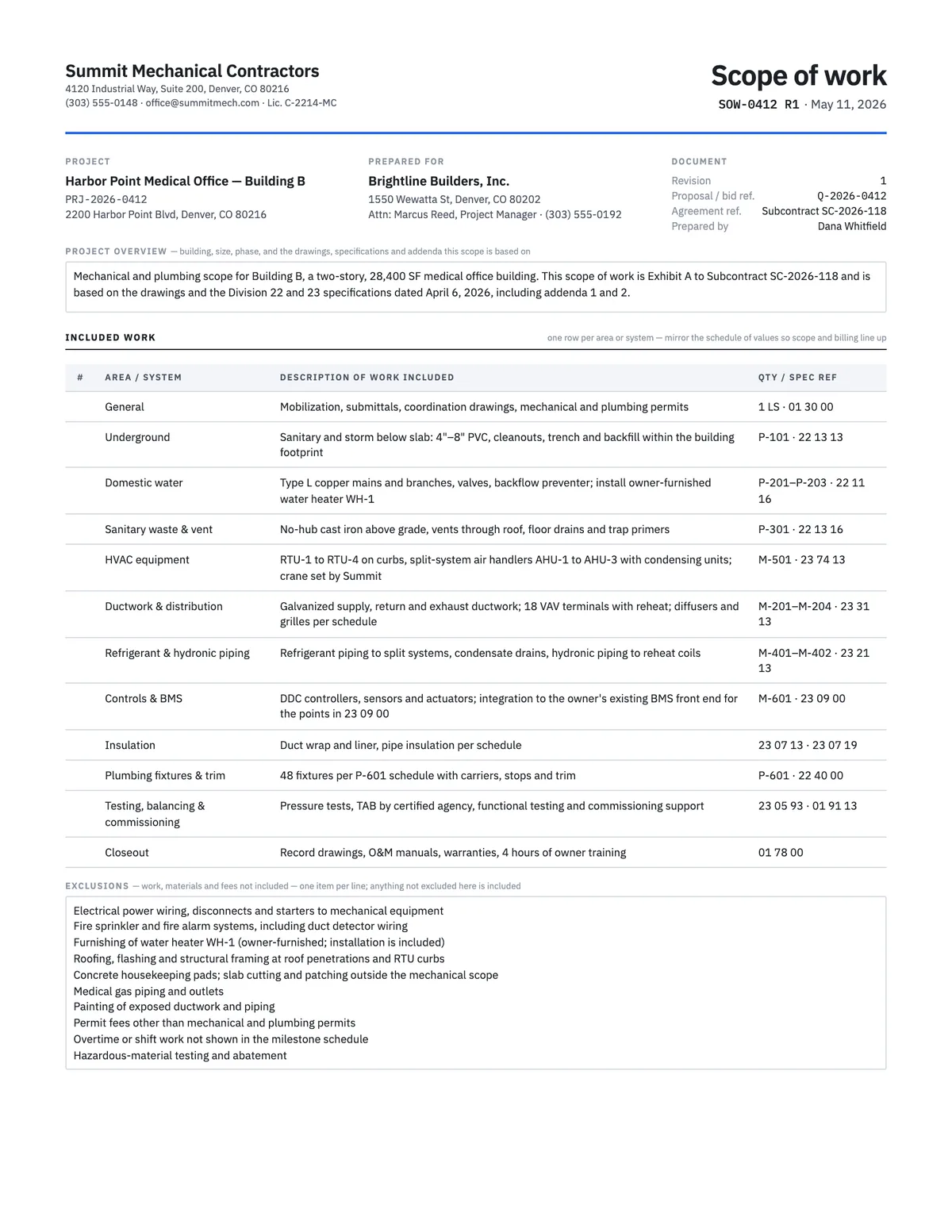
Scope of Work Template
Define exactly what is included, excluded, assumed and owed by others before anyone signs.
Word · PDF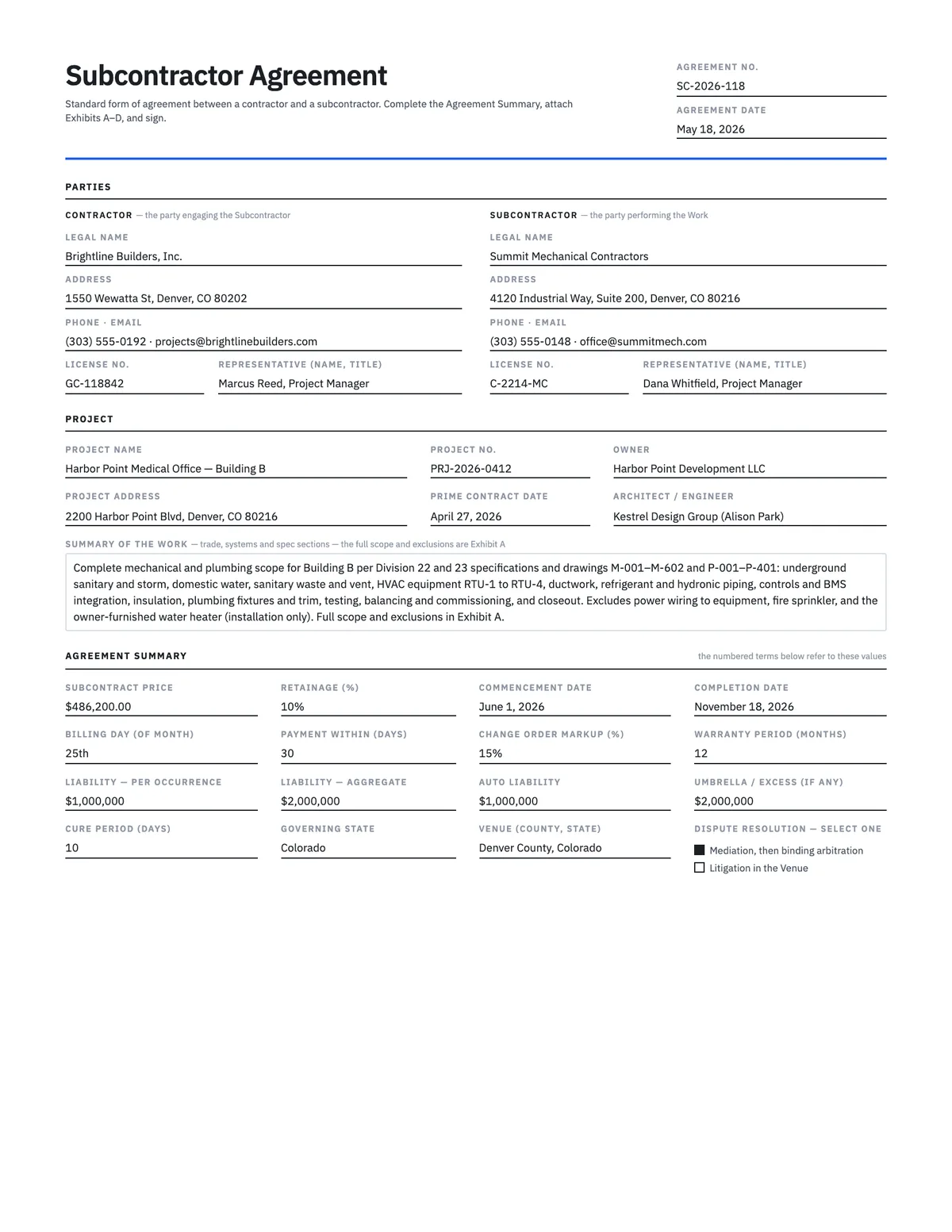
Subcontractor Agreement Template
15-section standard-form subcontract — scope, retainage, written change orders, lien waivers, insurance.
Word · PDFFree calculators and price data for this work: Markup vs Margin Calculator · Labor Burden Calculator · Construction material prices
Stop retyping proposals
Build the estimate once, generate the proposal PDF from the same numbers, collect the e-signature from an emailed link, and turn the win into a project with the contract value already in place.
$79/month flat · 14-day free trial · No credit card required
General-purpose form, not legal advice. Have your attorney review the terms and confirm they fit your state and the bid documents before relying on them.