
Free template
Subcontractor Agreement Template
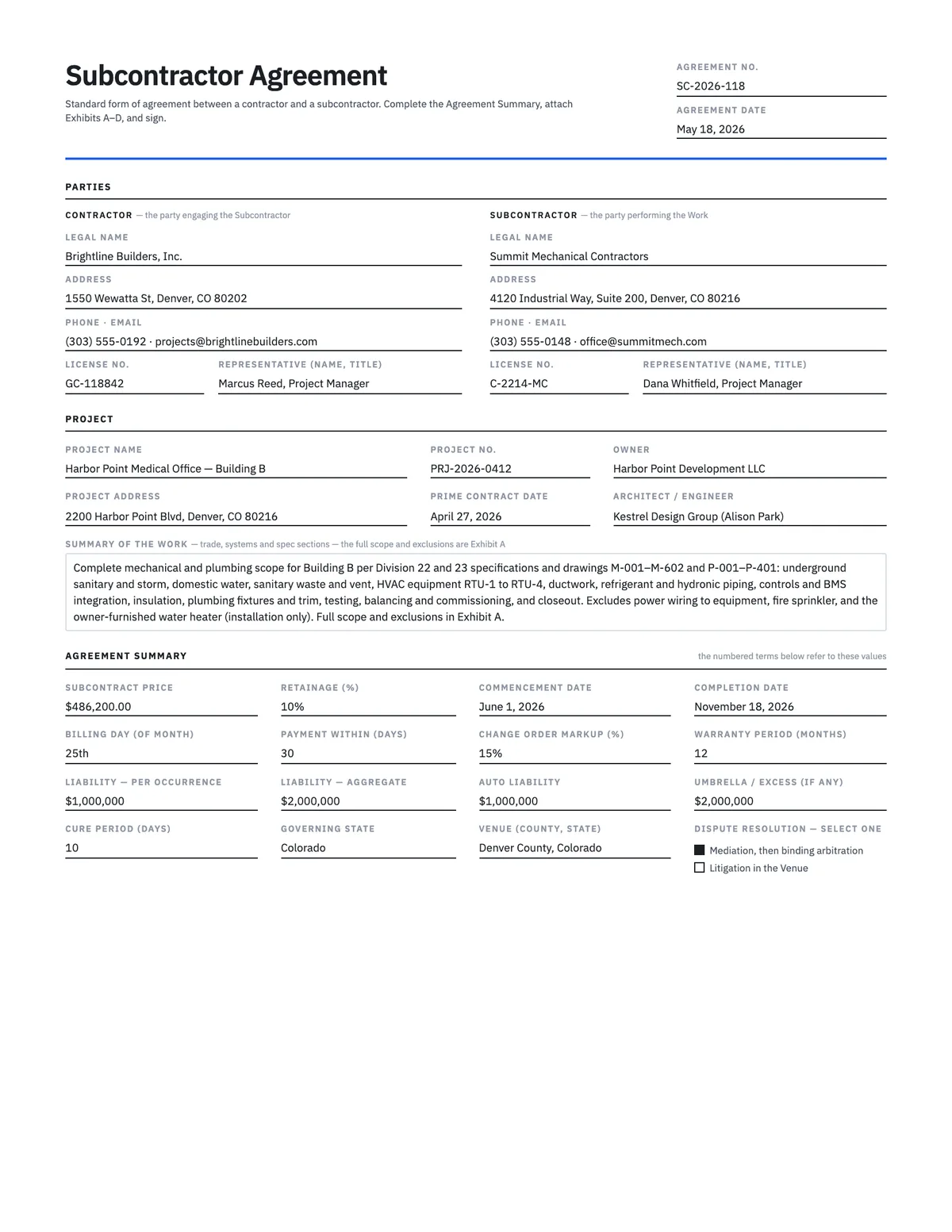
A 15-section standard form of agreement between a contractor and a subcontractor, with every deal term — price, retainage, billing day, insurance limits, warranty, dispute forum — on a one-page Agreement Summary the clauses refer to. Editable Word document and a fillable PDF, plus a completed example showing a $486,200 mechanical subcontract.
Free · No email required · Free to use and share for your own business
Updated September 17, 2026 · Built by the BuildWorkPro team, checked on real subcontractor jobs.
What's in the template
How to fill it out
-
1
Fill in the parties and the project
Legal names as they appear on licenses and insurance, addresses for notices, license numbers, and the representative on each side who can answer a question or sign a change order. Add the owner, the prime contract date and the architect so the flow-down clause has something to point to.
-
2
Summarize the Work and build Exhibit A
Write two or three sentences on page 1 — trade, systems, spec sections — and put the full scope, the drawing list and the exclusions in Exhibit A. Work not listed as excluded is included, so the exclusions list is where your margin lives. The free scope of work template is built to be that exhibit.
-
3
Set the money terms on the Agreement Summary
Subcontract price, retainage percentage, the day of the month applications are due, how many days after the application payment is due, and the markup allowed on change orders. The clauses refer to these values by name, so you never hunt through the text for a blank.
-
4
Set the time, insurance and risk terms
Commencement and completion dates, the warranty period in months, general liability per-occurrence and aggregate limits, auto and umbrella limits, the cure period for a breach, the governing state and venue, and whether disputes go to mediation-then-arbitration or to court.
-
5
Attach the exhibits, review, sign
Exhibit B is the schedule of values every pay application will bill against; C is the project schedule; D is the insurance certificates. Have an attorney check the form against your state, then sign — on paper or electronically, both parties, dated. Initial each attached exhibit on the last page.
What a subcontractor agreement is, and who issues it
A subcontractor agreement (subcontract) is the contract between a general contractor and a trade contractor for a defined piece of a larger project. It sits under the prime contract between the GC and the owner and flows the relevant parts of that contract down to you: the drawings and specifications, the schedule, the insurance requirements, and usually the payment rhythm. What it adds is the deal between the two of you — price, retainage, how changes are priced, what happens when someone is late, and who carries which risk.
On most commercial work the GC hands you their form, often after a letter of intent has held the award while it is drafted. You will use this template in three situations: a direct-to-owner job where you are the prime contractor and need a subcontract for your own sub-tier trades; a smaller GC who has no paper of their own; and as the baseline you read a GC's form against, so you can see which clauses were removed and which were tilted. A subcontract is a different animal from a construction contract between an owner and a contractor, and from a purchase order — see the comparison below.
How this template is organized: the Agreement Summary
Most free subcontract forms scatter blanks through the clauses — retainage of ___% released upon ___ — and you fill them by reading every page. This one puts every deal-specific value on page 1 in an Agreement Summary: parties, project, a short summary of the Work, and a grid of named terms. The fifteen numbered sections then refer to those terms by name: "the Retainage Percentage stated in the Agreement Summary," "the Cure Period," "the Venue." Two things follow. Nobody has to hunt for a blank, and the clause text never needs editing to close a deal — you negotiate the Summary, attach the exhibits, and sign.
The fifteen sections, and the ones that decide whether you get paid
Scope of Work; Contract Documents; Subcontract Price; Progress Payments and Retainage; Changes in the Work; Schedule; Insurance; Licenses, Permits and Compliance; Safety; Warranty; Indemnification; Liens and Waivers; Termination and Suspension; Disputes and Governing Law; and General Provisions. Four of them do most of the work for a subcontractor:
- Section 4 — Progress Payments and Retainage. Applications are due on the Billing Day, payment is due a fixed number of days later, and the contractor must dispute in writing within seven days and pay the undisputed balance. Final payment is tied to a checklist you control: punch list done, closeout documents delivered, final lien waiver furnished.
- Section 5 — Changes in the Work. No changed work without a signed change order; a seven-day notice window; three pricing methods including cost plus the Change Order Markup from the Summary; and a rule that directed work is tracked on daily T&M tickets until the change order is issued. Pair it with the change order template.
- Section 6 — Schedule. Extensions for owner, contractor, weather and other-trade delay with a notice deadline; compensable delay when the contractor or owner causes it; and liquidated damages only if a rate is stated in Exhibit A.
- Section 12 — Liens and Waivers. A conditional waiver with each application and an unconditional waiver for the previous payment, in the form your state requires, and an express statement that nothing waives lien or bond rights in advance of payment. The lien waiver forms follow the same exchange.
Section 9, Safety, is new in this edition: a competent person on site whenever your crews are, JSAs on request, same-day incident reporting, and the contractor's right to stop work for an imminent hazard — the terms GC safety officers now expect to see in writing.
A worked example
The completed example is the subcontract behind every other sample on this site: Brightline Builders engages Summit Mechanical Contractors for the mechanical and plumbing scope of the Harbor Point Medical Office, Building B. Subcontract price $486,200.00; retainage 10%; applications due by the 25th, paid within 30 days; 15% markup on change orders; commencement June 1, 2026 and completion November 18, 2026; general liability $1,000,000 per occurrence and $2,000,000 aggregate, $1,000,000 auto, $2,000,000 umbrella; a 12-month warranty; a 10-day cure period; Colorado law, Denver County venue, mediation then binding arbitration. The change order (CO-003), the pay application for August, and the lien waiver examples all bill against that same $486,200 contract with the same 10% retainage, so you can follow one job from signature to final payment.
Subcontractor agreement vs. construction contract vs. purchase order
| Document | Parties | Use it when |
|---|---|---|
| Subcontractor agreement | General contractor ↔ trade contractor | Your work is part of a larger project, billed monthly against a schedule of values, with retainage, and governed partly by a prime contract you did not sign. |
| Construction contract | Owner ↔ contractor | You contract directly with the property owner: a payment schedule tied to milestones, permits, warranty and the consumer notices some states require. |
| Purchase order | Buyer ↔ supplier | You are buying materials or a fixed deliverable — equipment, fabricated items, a delivery — with no ongoing labor on site. |
Clauses to watch for in a GC-issued subcontract
- Pay-if-paid. "Payment by the Owner is a condition precedent to payment to the Subcontractor" shifts the owner's credit risk to you. Ask for pay-when-paid with an outside date, and read the retainage guide for how release timing interacts with it.
- No damages for delay. Your only remedy for a GC-caused delay is more time, never money. This template makes contractor- and owner-caused delay compensable.
- Broad-form indemnity. You indemnify the GC even for the GC's own negligence. Many states void it; this template is mutual and comparative.
- Notice windows measured in hours. A 48-hour claim notice is designed to be missed. The template uses seven calendar days and lets a shorter prime-contract period apply only if you were given it.
- Advance lien waivers. Language waiving lien rights on signing, rather than on payment. See lien waivers explained.
- Retainage above your state's cap, or with no release trigger. Write the percentage and the release event into the Summary and make the statute control.
From signed subcontract to a running job
In BuildWorkPro a won bid converts straight into a project, the signed subcontract lives on its Documents tab, the estimate seeds the schedule of values for pay applications, and change orders are priced against the contract and e-signed from an emailed link. Construction project management software for $79/month flat, 14-day free trial.
See project management in BuildWorkProFrequently asked questions
What should a subcontractor agreement include?
At minimum: the scope of work with exclusions, the subcontract price, payment terms including retainage and a billing schedule, a written change-order requirement, the project schedule, insurance requirements, warranty terms, indemnification, lien waiver procedure, and how disputes are resolved. This template covers all fifteen standard sections, and every deal-specific value — price, retainage, billing day, payment period, insurance limits, warranty, cure period, governing law — sits on a one-page Agreement Summary the clauses refer to.
Is a subcontractor agreement legally binding?
Yes — once both parties sign, it is an enforceable contract. That is exactly why the change-order and payment clauses matter: they make the paper trail, not memory, control what you are owed. Have an attorney review any agreement before you rely on it; retainage limits, prompt-payment rules, and lien waiver forms vary by state.
Who provides the agreement — the GC or the sub?
On commercial work the general contractor usually issues their subcontract form, and you negotiate from it. This template is for the other cases: direct-to-owner jobs, smaller GCs without paper, and your own sub-tier subcontractors. Reading a standard form also makes you a sharper negotiator of a GC-issued one — you will know which clauses are missing and which have been tilted.
What is the difference between pay-when-paid and pay-if-paid?
A pay-when-paid clause makes the owner's payment the timing for yours: the GC must still pay within a reasonable time even if the owner never does. A pay-if-paid clause makes the owner's payment a condition of yours, shifting the owner's credit risk to you; several states refuse to enforce it or require very explicit language. This template uses neither — payment is due a fixed number of days after the application — so if a GC-issued form contains one, you will recognize it as a change from the baseline.
How much retainage can a general contractor hold on a subcontract?
Ten percent is the traditional figure and five percent is common on larger or public work; many states cap retainage or require it to step down or be released within a set time after completion. The template has a Retainage Percentage field on the Agreement Summary and states that where a statute limits the rate or the holding period, the statute controls — so the number you write in is the ceiling, not a way around the law.
What is the difference between a subcontractor agreement and a purchase order?
A purchase order buys materials or a narrow, fixed deliverable; a subcontractor agreement governs ongoing labor on a project — scope, schedule, progress billing, retainage, changes, insurance, and warranty. If your work is billed monthly against a schedule of values, you want a subcontract, not a PO.
Can I sign it electronically?
Yes — properly executed e-signatures are legally binding in the United States under the federal ESIGN Act, and the General Provisions section of this template says so expressly. BuildWorkPro includes built-in legally binding e-signatures: send a bid or change order and your customer signs from an emailed link, with the certified signed PDF filed back on the record automatically.
Templates that go with this one
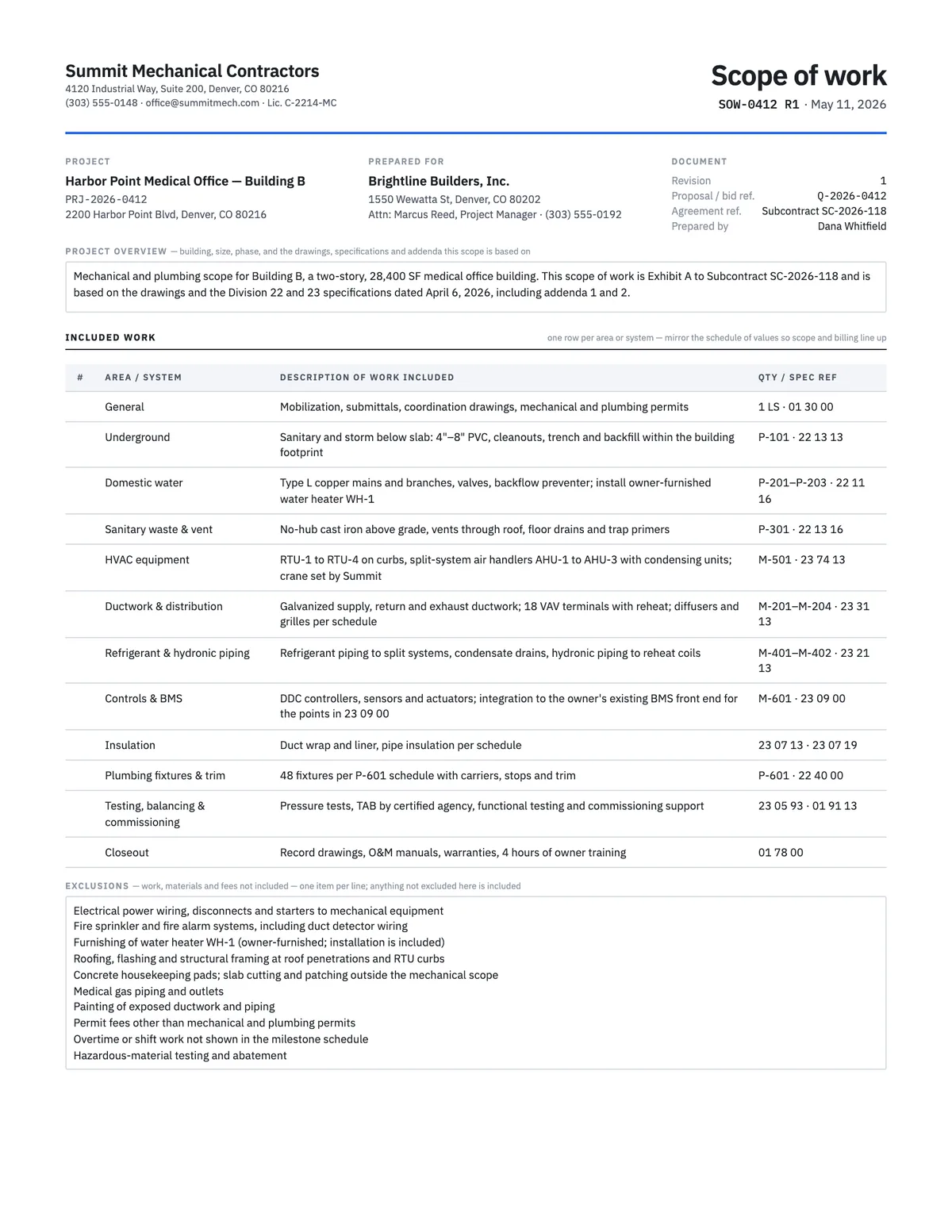
Scope of Work Template
Define exactly what is included, excluded, assumed and owed by others before anyone signs.
Word · PDF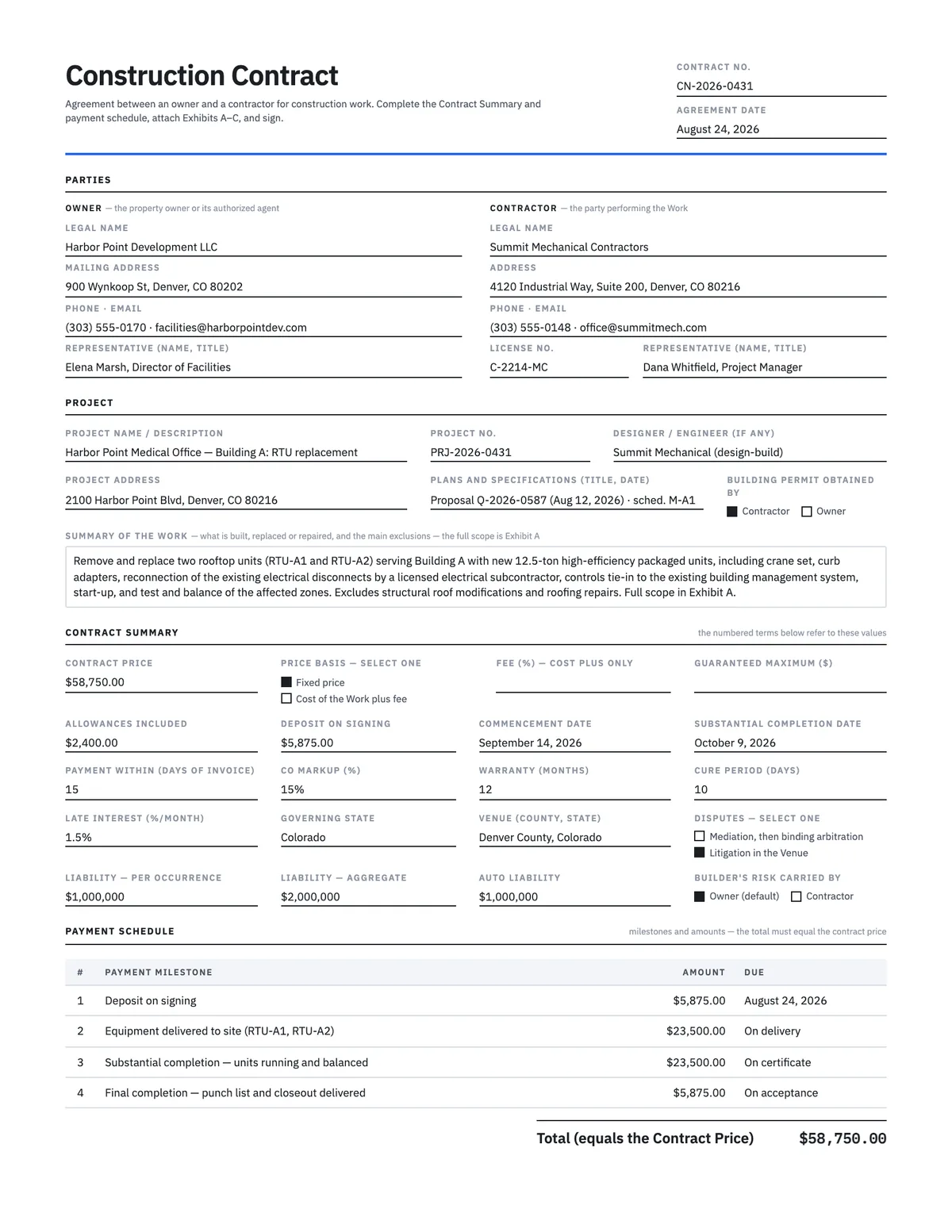
Construction Contract Template
Owner–contractor agreement for direct work: price, payment schedule, changes, warranty and termination.
Word · PDF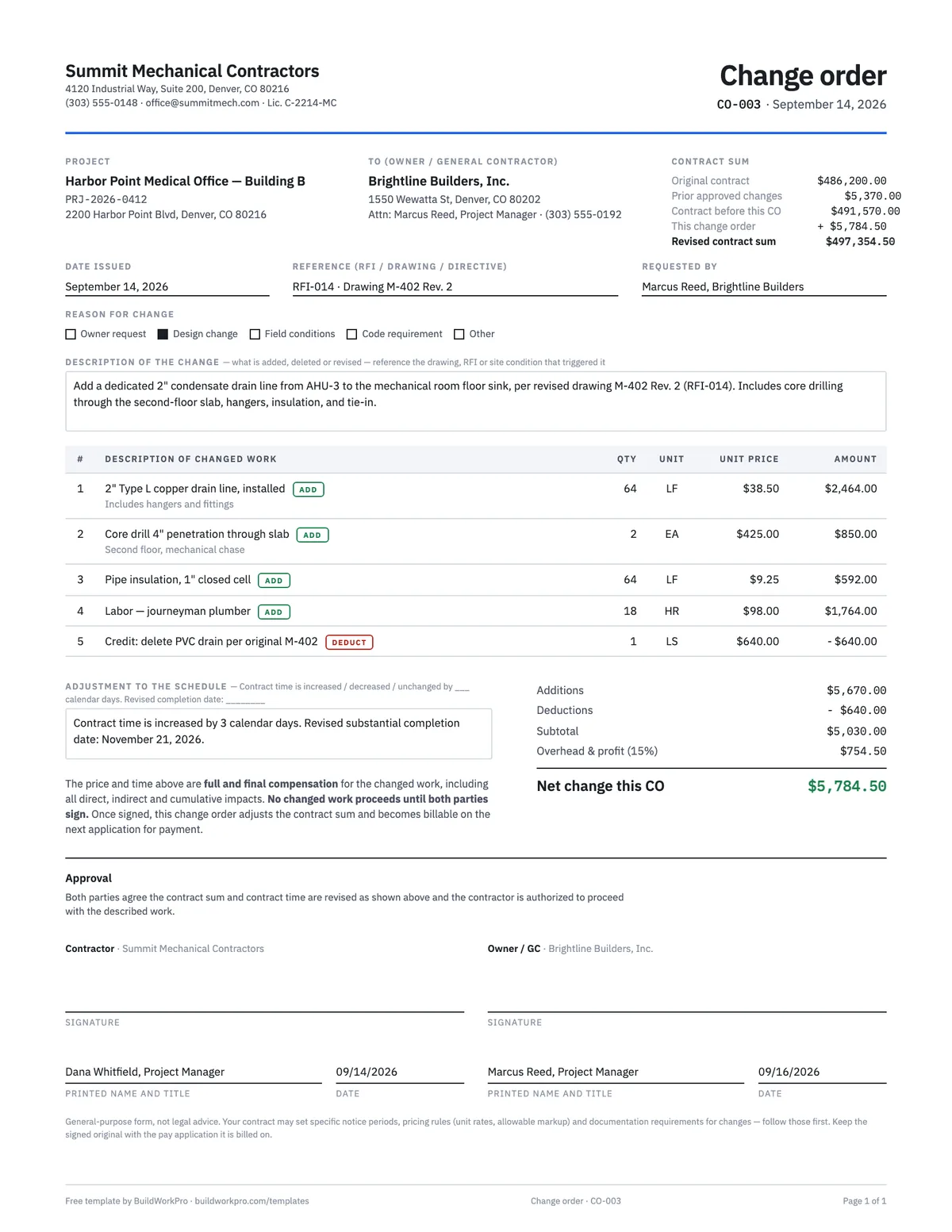
Construction Change Order Template
Price the change, adjust the contract sum and schedule, and get both signatures before the work starts.
PDF · Word · Excel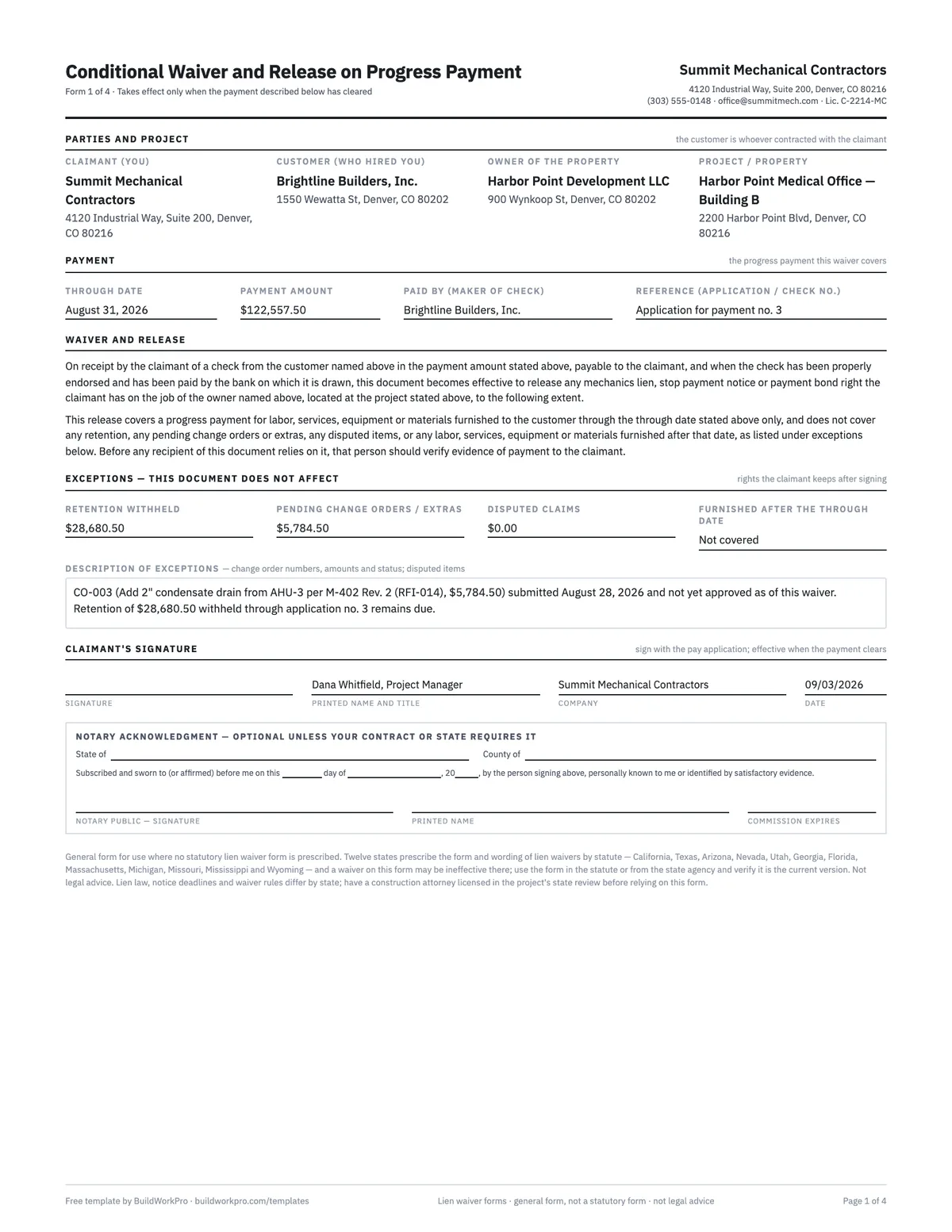
Lien Waiver Forms (4 types)
Conditional and unconditional waivers for progress and final payment, with the exception fields that protect you.
Word · PDFThe contract is step one. Getting paid against it is the job.
BuildWorkPro runs the rest of the loop this agreement describes: bids with legally binding e-signatures, written change orders your customer approves online, and pay applications with retainage handled.
$79/month flat · 14-day free trial · No credit card required
Not legal advice. This template is a general-purpose starting point; construction contract requirements — retainage limits, prompt-payment rules, lien waiver forms, indemnity and pay-if-paid restrictions, licensing — vary by state. Have a licensed attorney review before use.